Several weeks ago I gave a talk related to my forthcoming book at the University of Southern California. Watch as I attempt to summarize four years of research and a 300-page book in less than an hour. :)
Showing posts with label Private Enterprise. Show all posts
Showing posts with label Private Enterprise. Show all posts
 It was only a matter of time.
The privately-held Chinese automaker Geely has announced that it will be forming a joint venture with its subsidiary Volvo. As you may remember, Geely’s owner, Li Shufu conducted a high-profile purchase of the Swedish automaker Volvo from Ford in 2010.
The concern at the time had been that Geely simply wanted to strip away Volvo’s intellectual property for itself, but Li Shufu assured observers that the two entities would remain separate: “Volvo is Volvo, and Geely is Geely.” And indeed, the purchase was structured so that both the Hong Kong-listed Geely Motors and Volvo are both subsidiaries of a holding company controlled by Li Shufu. (In other words, Geely doesn’t own Volvo, technically, Li Shufu does.)
So why is Geely now forming a JV with Volvo? Because it has to in order to build cars in China. China’s rules require that any “foreign” automaker that wants to assemble cars in China may only do so through a joint venture with a Chinese automaker, and the foreign entity may hold no more than 50 percent of the JV. Since Volvo is still headquartered in Sweden, it is considered foreign.
The icing on the cake for China here is that, like all other foreign automakers who have sought permission from Beijing for expansion or establishment of a new venture anytime during the past two years, Volvo is also being required to “assist” Geely in building a Chinese-branded car.
Until now, this has only applied to state-owned enterprises because only state-owned enterprises had joint ventures with foreign automakers (with the exception of a small JV between BYD and Daimler to develop electric vehicles). The assumption had been that the SOEs, which had been dragging their feet in terms of developing their own brands, would be “given” slightly out-of-date technology by their foreign partners. They would then produce cars under a Chinese brand name using the foreign technology and designs. (I have previously written about this phenomenon, which I refer to as "sub-brands" or “JV Brands.”)
What is interesting here is that Geely, unlike the SOEs cannot be accused of “dragging its feet” in developing Chinese brands. Indeed, Chinese brands are all Geely has ever made!
So what does this mean for Volvo? What it means is that Volvo will simply be handing over technology onto which will be slapped a Geely-owned Chinese brand name.
Perhaps Li Shufu would now like to change his quote to, “Volvo is Geely, and Geely is Volvo.”

The Wall Street Journal reports on a brief debate that took place yesterday between US Ambassador to China, Gary Locke and an advisor to the People's Bank of China, Li Daokui. The exchange took place during a panel discussion at the World Economic Forum meeting currently taking place in Dalian, China.

The apparently civil discussion surrounded a disagreement as to the repercussions of China's difficulties in enforcing intellectual property rights (IPR) protections. In short, Locke expressed his view that lack of IPR enforcement would stifle Chinese innovation. Li, on the other hand, merely expressed his disagreement and noted that China's policy focus instead needed to be on supporting entrepreneurs and removing barriers to their success. (Notice how Li cleverly took Locke's cue and changed the topic from IPR to innovation?)
So who is right about innovation? Where should China focus its policy in order to better support innovation? Should it beef up IPR enforcement, or should it focus on removing barriers to the private sector? Which would give it the biggest bang for its policy buck? (Not that this is necessarily an either/or proposition -- China is big and rich enough now to do both -- but humor me on this.)
Some of my readers may be surprised to learn that I think Li Daokui was right. While Locke was certainly carrying out his duty as Ambassador by saying that China needs to improve IPR protection, the truth is that IPR protection has very little to do with innovation in a developing country like China. In fact, history tells us that, since the dawn of the Industrial Revolution, every subsequent country to jump on the development bandwagon has copied those who came before.
My research on China's auto industry reveals that the most innovative among China's automakers are the private and independent automakers, not the massive state-owned enterprises (SOEs) with their foreign joint venture partners. While private players have yet to introduce any real breakthrough innovation, their progress in developing new energy vehicles and unique Chinese brands is ahead of the SOEs. The reason for this (and you'll have to take my word for it until my book comes out) is twofold.
First, leadership positions in SOEs are essentially political positions. The men who run these companies have their eyes on their next job, which will be a political appointment to run an association or a local government, or even to become a Vice Minister or Minister in the central government. In order to better assure themselves of a good position, they tend to be risk-averse in their decision making.
Second, because these guys have short-term investment horizons, "wasting" money on R&D is not high on their agendas. R&D spending only helps the next guy. It is much easier to rake in profits building and selling foreign branded cars. They simply lack the career incentives to take the kind of risks that result in significant innovation.
(Here is another story today about how "JV brands" have not resulted in the innovation that the central government had been hoping for. Why? Again, forcing foreign partners to hand over technology does not translate into innovation, especially when leadership incentives are not changed. I previously wrote about this "JV brands" or "sub brands" issue several months back.)
So while Li Daokui seemed to be changing the subject above, he was actually addressing Locke's point about innovation. And if China's auto industry is any kind of indication for China as a whole, the central government would do well to follow Li's advice and remove the barriers that continue to marginalize private business in China.
Of course, as an American, I would like to see the home team do well, so if China continues to insist on a preponderance of state control over all of its major industries, I believe that will ultimately be to the advantage of China's competitors. And they need every advantage they can get.
_______________
* William Kingston, “An Agenda for Radical Intellectual Property Reform,” in International Public Goods and Transfer of Technology Under a Globalized Intellectual Property Regime, ed. Keith E. Maskus and Jerome H. Reichman (New York: Cambridge University Press, 2005), 658.

The apparently civil discussion surrounded a disagreement as to the repercussions of China's difficulties in enforcing intellectual property rights (IPR) protections. In short, Locke expressed his view that lack of IPR enforcement would stifle Chinese innovation. Li, on the other hand, merely expressed his disagreement and noted that China's policy focus instead needed to be on supporting entrepreneurs and removing barriers to their success. (Notice how Li cleverly took Locke's cue and changed the topic from IPR to innovation?)
So who is right about innovation? Where should China focus its policy in order to better support innovation? Should it beef up IPR enforcement, or should it focus on removing barriers to the private sector? Which would give it the biggest bang for its policy buck? (Not that this is necessarily an either/or proposition -- China is big and rich enough now to do both -- but humor me on this.)
Some of my readers may be surprised to learn that I think Li Daokui was right. While Locke was certainly carrying out his duty as Ambassador by saying that China needs to improve IPR protection, the truth is that IPR protection has very little to do with innovation in a developing country like China. In fact, history tells us that, since the dawn of the Industrial Revolution, every subsequent country to jump on the development bandwagon has copied those who came before.
...every country that became economically great began by copying: the Germans copied the British; the Americans copied the British and the Germans, and the Japanese copied everybody.*This is not to excuse the Chinese companies that blatantly copy foreign products and the government that often chooses to look the other way, but since Locke chose to introduce innovation into the discussion, the issue deserves a closer look.
My research on China's auto industry reveals that the most innovative among China's automakers are the private and independent automakers, not the massive state-owned enterprises (SOEs) with their foreign joint venture partners. While private players have yet to introduce any real breakthrough innovation, their progress in developing new energy vehicles and unique Chinese brands is ahead of the SOEs. The reason for this (and you'll have to take my word for it until my book comes out) is twofold.
First, leadership positions in SOEs are essentially political positions. The men who run these companies have their eyes on their next job, which will be a political appointment to run an association or a local government, or even to become a Vice Minister or Minister in the central government. In order to better assure themselves of a good position, they tend to be risk-averse in their decision making.
Second, because these guys have short-term investment horizons, "wasting" money on R&D is not high on their agendas. R&D spending only helps the next guy. It is much easier to rake in profits building and selling foreign branded cars. They simply lack the career incentives to take the kind of risks that result in significant innovation.
(Here is another story today about how "JV brands" have not resulted in the innovation that the central government had been hoping for. Why? Again, forcing foreign partners to hand over technology does not translate into innovation, especially when leadership incentives are not changed. I previously wrote about this "JV brands" or "sub brands" issue several months back.)
So while Li Daokui seemed to be changing the subject above, he was actually addressing Locke's point about innovation. And if China's auto industry is any kind of indication for China as a whole, the central government would do well to follow Li's advice and remove the barriers that continue to marginalize private business in China.
Of course, as an American, I would like to see the home team do well, so if China continues to insist on a preponderance of state control over all of its major industries, I believe that will ultimately be to the advantage of China's competitors. And they need every advantage they can get.
_______________
* William Kingston, “An Agenda for Radical Intellectual Property Reform,” in International Public Goods and Transfer of Technology Under a Globalized Intellectual Property Regime, ed. Keith E. Maskus and Jerome H. Reichman (New York: Cambridge University Press, 2005), 658.
*UPDATED* - Who is Li Shufu's "Associate"?
Categories:
Auto Industry,
Central BizGov,
Corporate Governance,
Local BizGov,
Private Enterprise
0 comments
0 comments
UPDATE below...
_______________________
From the corporate governance files...
Geely is probably best known as the Chinese auto company that bought Volvo from Ford last year. It is also known as China's largest "private" automaker. I put the term "private" in quotation marks because, in China, the meaning of the word is not quite the same as in most developed countries.
As is generally well-known among China watchers, the government -- particularly local governments -- have influence on private businesses that goes beyond mere regulation. And the larger the "private" business, the greater the government's influence.
At a minimum, the local state is everyone's landlord. At the extreme, a local government can force private businesses to sell out to state owned businesses, as has been done with alarming frequency in the coal industry, or local officials can demand an ownership share.
On the positive side, not all governments necessarily seek to own or control private businesses, and many even provide help to private businesses in startup mode such as tax breaks, free or cheap land and utilities, access to bank loans, etc.
But the question that this kind of help often raises is, what does the government expect in return? Is it enough to be a successful business that employs people and pays its taxes on time, or do local officials expect more?
Because we always hear that Geely is a "private" business, I decided to try to find out exactly how "private" Geely is -- at least in terms of legal ownership. Geely is listed on the Hong Kong Stock Exchange, so its audited financial statements and accompanying notes are made available on the HKSE website. Geely's latest annual report (2009) is available here (pdf).
In an effort to determine who exactly owns Geely, I constructed the following partial org chart from information available in the annual report. The listed company is in the purple box. About 48 percent of the Geely Auto Holdings is held by public shareholders, and the remaining majority of shares are owned by a company named Proper Glory Holdings which is incorporated in the British Virgin Islands.
According to the annual report, Proper Glory is ultimately controlled by Geely's Chairman "Mr. Li Shufu and his associate," but for some reason it does not say who this "associate" is. (Here I am referring to the yellow box at the top of the diagram.)
Looking back over the years, this "associate" did not begin to be mentioned as an owner until 2008, but he, she or it seems to be pretty important. If you do the math, this anonymous "associate" could potentially control up to 35 percent of the listed company. And if "associate" owns as little as 75 percent of Zhejiang Geely Holding Group Ltd, he, she or it would be the listed company's largest single shareholder with a 26 percent interest.
Furthermore, as you can see at the bottom of the org chart, Li Shufu and this mysterious "associate" also own 9% of the auto plants.

I contacted several friends who are even more knowledgeable than I about China's auto industry, and their assumption, like mine, is that Li Shufu controls the company. One suggested, however, that the "associate" may be Li's son or brother. Another speculated that it could even be a Communist Party member to whom Li is beholden for something.
I am not suggesting that there is anything illegal going on here, but it seems to me that Geely's auditor, the Hong Kong office of Grant Thornton (which has recently lost most of its employees to BDO) is not doing a thorough enough job of reporting by allowing a shareholder with the potential to control the company to remain completely anonymous.
If there is nothing to hide, why not reveal the name of the "associate"? At a minimum, why not reveal the respective ownership shares that Li Shufu and "associate" have in Zhejiang Geely Holding Group Ltd?
______________
UPDATE, January 28, 2011:
Thanks to one of my readers for bringing this to my attention.
Above I said that Li Shufu's unnamed "associate" could control the listed Geely company with 75% ownership of Zhejiang Geely Holding Group Ltd. (ZGHGL). That's not entirely accurate. I was thinking more like an accountant than a lawyer. (And I am neither, though my work previously involved a lot of accounting).
I should have more accurately said that the "associate" could control Geely with only a majority ownership of ZGHGL. If the associate held 50% plus one share of ZGHGL, then he would effectively control Proper Glory, which, because it owns 51.3%, also controls the listed Geely Company.
Again, while my assumption is that Li Shufu is the controlling owner of Geely, until someone reveals how much of ZGHGL the associate owns, we cannot be entirely sure of that.
Subsequent to the above post, I have also received information from someone who knows the identity of the associate. This "associate" is apparently an influential Party member who helped Geely to get central government approval for the Volvo purchase. Unfortunately, I cannot reveal the source, but it is someone whom I trust, and who is in a position to know.
If that is indeed true, then, if I were a Geely shareholder, I would be even more interested to know how much influence and/or control the "associate" actually has.
_______________________
From the corporate governance files...
Geely is probably best known as the Chinese auto company that bought Volvo from Ford last year. It is also known as China's largest "private" automaker. I put the term "private" in quotation marks because, in China, the meaning of the word is not quite the same as in most developed countries.
As is generally well-known among China watchers, the government -- particularly local governments -- have influence on private businesses that goes beyond mere regulation. And the larger the "private" business, the greater the government's influence.
At a minimum, the local state is everyone's landlord. At the extreme, a local government can force private businesses to sell out to state owned businesses, as has been done with alarming frequency in the coal industry, or local officials can demand an ownership share.
On the positive side, not all governments necessarily seek to own or control private businesses, and many even provide help to private businesses in startup mode such as tax breaks, free or cheap land and utilities, access to bank loans, etc.
But the question that this kind of help often raises is, what does the government expect in return? Is it enough to be a successful business that employs people and pays its taxes on time, or do local officials expect more?
Because we always hear that Geely is a "private" business, I decided to try to find out exactly how "private" Geely is -- at least in terms of legal ownership. Geely is listed on the Hong Kong Stock Exchange, so its audited financial statements and accompanying notes are made available on the HKSE website. Geely's latest annual report (2009) is available here (pdf).
In an effort to determine who exactly owns Geely, I constructed the following partial org chart from information available in the annual report. The listed company is in the purple box. About 48 percent of the Geely Auto Holdings is held by public shareholders, and the remaining majority of shares are owned by a company named Proper Glory Holdings which is incorporated in the British Virgin Islands.
According to the annual report, Proper Glory is ultimately controlled by Geely's Chairman "Mr. Li Shufu and his associate," but for some reason it does not say who this "associate" is. (Here I am referring to the yellow box at the top of the diagram.)
Looking back over the years, this "associate" did not begin to be mentioned as an owner until 2008, but he, she or it seems to be pretty important. If you do the math, this anonymous "associate" could potentially control up to 35 percent of the listed company. And if "associate" owns as little as 75 percent of Zhejiang Geely Holding Group Ltd, he, she or it would be the listed company's largest single shareholder with a 26 percent interest.
Furthermore, as you can see at the bottom of the org chart, Li Shufu and this mysterious "associate" also own 9% of the auto plants.
I contacted several friends who are even more knowledgeable than I about China's auto industry, and their assumption, like mine, is that Li Shufu controls the company. One suggested, however, that the "associate" may be Li's son or brother. Another speculated that it could even be a Communist Party member to whom Li is beholden for something.
I am not suggesting that there is anything illegal going on here, but it seems to me that Geely's auditor, the Hong Kong office of Grant Thornton (which has recently lost most of its employees to BDO) is not doing a thorough enough job of reporting by allowing a shareholder with the potential to control the company to remain completely anonymous.
If there is nothing to hide, why not reveal the name of the "associate"? At a minimum, why not reveal the respective ownership shares that Li Shufu and "associate" have in Zhejiang Geely Holding Group Ltd?
______________
UPDATE, January 28, 2011:
Thanks to one of my readers for bringing this to my attention.
Above I said that Li Shufu's unnamed "associate" could control the listed Geely company with 75% ownership of Zhejiang Geely Holding Group Ltd. (ZGHGL). That's not entirely accurate. I was thinking more like an accountant than a lawyer. (And I am neither, though my work previously involved a lot of accounting).
I should have more accurately said that the "associate" could control Geely with only a majority ownership of ZGHGL. If the associate held 50% plus one share of ZGHGL, then he would effectively control Proper Glory, which, because it owns 51.3%, also controls the listed Geely Company.
Again, while my assumption is that Li Shufu is the controlling owner of Geely, until someone reveals how much of ZGHGL the associate owns, we cannot be entirely sure of that.
Subsequent to the above post, I have also received information from someone who knows the identity of the associate. This "associate" is apparently an influential Party member who helped Geely to get central government approval for the Volvo purchase. Unfortunately, I cannot reveal the source, but it is someone whom I trust, and who is in a position to know.
If that is indeed true, then, if I were a Geely shareholder, I would be even more interested to know how much influence and/or control the "associate" actually has.
The missing link in China's auto development?
Categories:
Auto Industry,
Central BizGov,
Foreign Enterprise,
Local BizGov,
Private Enterprise,
SOEs
0 comments
0 comments
An interesting article in today’s WSJ by ace China auto reporter Nori Shirouzu summarizes an interesting trend in China’s auto development. China’s state-owned automakers, along with their foreign joint-venture partners, are beginning to develop China-only brands.
Battleground in the small car segment
At least part of the impetus behind this trend, I believe, is the popularity of small economy cars in China. Beginning in early 2009, when China halved the sales tax on cars with engines 1.6 liters or smaller, sales of these small cars have really blossomed. (The number of cars sold in the less than 1.6 liter category rose by 71 percent over 2008 while sales of larger cars rose by only 23 percent.) The tax on smaller cars was increased slightly at the beginning of 2010, but small cars have nevertheless remained hot sellers in China.
The good news for makers of Chinese-branded autos was that the foreigners had almost nothing to offer in the less than 1.6 liter space, so Chinese brands dominated. The bad news for Beijing, however, was that the SOEs also had very little to offer in this space. It was the private automakers (along with independent SOEs such as Chery) that benefited most.
New Strategy: Joint development
Enter this new strategy of jointly-developed, Chinese-branded cars that, nearly as I can tell, is a win-win for the big SOEs and their foreign partners – at least in the short-run.
This strategy appears to have two variations. One is for the Chinese and foreign partner to develop a car together, combining the intellectual property of both sides. SAIC-GM-Wuling have taken this route with the Baojun (pictured below). According to the authoritative China Car Times, “The platform was designed in Korea, whilst the body design was done in China with GM’s help, the brand was developed in China and also the engine was developed by [Shanghai Auto] in the UK technical center.”

Shirouzu’s article today reveals that Volkswagen and PSA Peugeot Citroen are considering a similar strategy.
The other variation is simply to re-badge an older model from the foreign partner. Honda and Nissan are doing this with their respective partners in China, Guangzhou Auto and Dongfeng Auto. Guangzhou-Honda is a new Linian model which is a re-badged Honda City from a few years back, and Dongfeng Nissan are building the Qichen from old Nissan technology.
What's driving this trend?
There are a couple of factors at work behind this trend. First, although China’s central government has been pushing hard for development of Chinese brands since China joined the WTO, only China’s independent automakers (both private and local SOEs without JV partners) have made significant headway in introducing Chinese brands. Yes, the big SOEs have also introduced their own brands, but they have been “developed” mostly through purchased technology. That is, the big SOEs have yet to demonstrate any real engineering prowess.
Second, there is a big gap between the foreign-branded, mid-sized cars sold in China and the small, Chinese-branded cars. It’s a gap in terms of both price and quality, and Chinese consumers understand this very well. This is why, despite the growth of Chinese brands (they now make up over 30 percent of passenger cars sold in China), Chinese consumers would still prefer a foreign brand if they can afford it.
The Missing Link
These new, jointly-developed, Chinese-branded cars are, I believe, the missing link between foreign- and Chinese-branded cars. And the fact that this kind of development is happening in almost all of China’s big SOEs at the same time tells me there is some kind of central coordination going on – either that, or it’s just a big coincidence. Regardless, I think the strategy here is to provide Chinese consumers with a new product intended to wean them away from foreign cars and make them more accepting of Chinese brands.
And, if I am right, this should call into question the future role of foreign automakers in China’s market.
Another interesting wrinkle to this story is of whether Chinese automakers are learning any better how to design their own cars.
What some of these SOEs are doing is simply buying (or being given) old designs by their foreign partners, and then slapping on a Chinese badge. On the other hand, China’s private automakers have essentially been doing that for years ... only, they don’t have foreign partners ... and, um, they don’t pay for the stuff they copy. But in the process, the private automakers have probably gotten better at auto design. Even the process of copying must have imparted to the private firms some useful engineering skills that the SOEs have yet really to develop.
Perhaps this new method of (legally) copying what their foreign partners have already done will impart to SOE engineers some of those same skills.
Battleground in the small car segment
At least part of the impetus behind this trend, I believe, is the popularity of small economy cars in China. Beginning in early 2009, when China halved the sales tax on cars with engines 1.6 liters or smaller, sales of these small cars have really blossomed. (The number of cars sold in the less than 1.6 liter category rose by 71 percent over 2008 while sales of larger cars rose by only 23 percent.) The tax on smaller cars was increased slightly at the beginning of 2010, but small cars have nevertheless remained hot sellers in China.
The good news for makers of Chinese-branded autos was that the foreigners had almost nothing to offer in the less than 1.6 liter space, so Chinese brands dominated. The bad news for Beijing, however, was that the SOEs also had very little to offer in this space. It was the private automakers (along with independent SOEs such as Chery) that benefited most.
New Strategy: Joint development
Enter this new strategy of jointly-developed, Chinese-branded cars that, nearly as I can tell, is a win-win for the big SOEs and their foreign partners – at least in the short-run.
This strategy appears to have two variations. One is for the Chinese and foreign partner to develop a car together, combining the intellectual property of both sides. SAIC-GM-Wuling have taken this route with the Baojun (pictured below). According to the authoritative China Car Times, “The platform was designed in Korea, whilst the body design was done in China with GM’s help, the brand was developed in China and also the engine was developed by [Shanghai Auto] in the UK technical center.”
The SAIC-GM-Wuling Baojun

Shirouzu’s article today reveals that Volkswagen and PSA Peugeot Citroen are considering a similar strategy.
The other variation is simply to re-badge an older model from the foreign partner. Honda and Nissan are doing this with their respective partners in China, Guangzhou Auto and Dongfeng Auto. Guangzhou-Honda is a new Linian model which is a re-badged Honda City from a few years back, and Dongfeng Nissan are building the Qichen from old Nissan technology.
What's driving this trend?
There are a couple of factors at work behind this trend. First, although China’s central government has been pushing hard for development of Chinese brands since China joined the WTO, only China’s independent automakers (both private and local SOEs without JV partners) have made significant headway in introducing Chinese brands. Yes, the big SOEs have also introduced their own brands, but they have been “developed” mostly through purchased technology. That is, the big SOEs have yet to demonstrate any real engineering prowess.
Second, there is a big gap between the foreign-branded, mid-sized cars sold in China and the small, Chinese-branded cars. It’s a gap in terms of both price and quality, and Chinese consumers understand this very well. This is why, despite the growth of Chinese brands (they now make up over 30 percent of passenger cars sold in China), Chinese consumers would still prefer a foreign brand if they can afford it.
The Missing Link
These new, jointly-developed, Chinese-branded cars are, I believe, the missing link between foreign- and Chinese-branded cars. And the fact that this kind of development is happening in almost all of China’s big SOEs at the same time tells me there is some kind of central coordination going on – either that, or it’s just a big coincidence. Regardless, I think the strategy here is to provide Chinese consumers with a new product intended to wean them away from foreign cars and make them more accepting of Chinese brands.
And, if I am right, this should call into question the future role of foreign automakers in China’s market.
Another interesting wrinkle to this story is of whether Chinese automakers are learning any better how to design their own cars.
What some of these SOEs are doing is simply buying (or being given) old designs by their foreign partners, and then slapping on a Chinese badge. On the other hand, China’s private automakers have essentially been doing that for years ... only, they don’t have foreign partners ... and, um, they don’t pay for the stuff they copy. But in the process, the private automakers have probably gotten better at auto design. Even the process of copying must have imparted to the private firms some useful engineering skills that the SOEs have yet really to develop.
Perhaps this new method of (legally) copying what their foreign partners have already done will impart to SOE engineers some of those same skills.
Let's have more competition!...Just kidding!
Categories:
Auto Industry,
Central BizGov,
Foreign Enterprise,
Industrial Policy,
Private Enterprise,
SOEs
0 comments
0 comments
An interesting bit of news came across the teletype today. The annual China-Europe Auto Manufacturers' Forum took place toward the end of last month (October 2010). Sometime during the discussion, the Assistant Director of the State Council's think tank, the Development Research Council, made a provocative statement that apparently freaked out a lot of people.
Let the foreigners have more than 50 percent?
The Assistant Director, Professor Liu Shijin, someone whose views on the auto industry are highly respected and influential, suggested that it was about time for China to end its 50 percent ownership restriction on foreign auto companies that invest in China. Currently, China's policy limits foreign auto assembly joint-venture (JV) partners to an ownership stake of 50 percent or less. (This only applies to whole vehicle assembly operations; parts companies may be wholly foreign-owned.)
(A Chinese source for Liu's statement and the controversy that followed may be found here.)
According to a writer for China's "First Finance" website, "the audience members with blonde hair and blue eyes applauded and nodded in agreement, while those with dark hair and dark eyes shook their heads [in disagreement]." I think what the writer intended to convey was that the foreigners in the audience agreed with Liu and the Chinese did not.
No! We're still not ready!
The Chinese arguments against Liu echoed those made prior to China’s joining the WTO: the Chinese auto industry is not yet mature enough to take on the foreigners head-on. If restrictions were lifted, foreigners would completely occupy China’s market to the exclusion of the Chinese manufacturers.
However, there was at least one Chinese auto executive who fully agreed with Liu: Li Shufu, Chairman of Geely. Li was later quoted:
What Li most likely expects is that increased foreign competition within China would more quickly drive out the weaker competitors. That, of course, is anathema to the central government.
Since an overwhelming majority of China’s automakers are state-owned, it logically follows that an overwhelming majority of the weaker players are state-owned. And because the auto industry has been designated as a "pillar" industry since the mid-80s, it just wouldn't do to have an auto industry dominated by foreign and/or private enterprises.
Well, ... nevermind
The interesting news that came across the wires today is that Liu Shijin has now completely backed away from his earlier suggestion: "I never said I support opening up the restrictions on foreign investment."
Setting aside the fact that he clearly said exactly that at the conference, we have to ask why he's now backing down. Either he said something he shouldn't have, and was threatened with punishment if he didn't go to the media and retract what he said, or he was deliberately floating a trial balloon to gauge the reaction.
Knowing that Chinese planners at the NDRC and MIIT are hard at work on the next version of China's auto policy right now, I am leaning toward the latter explanation. And since he's backing away, it seems reasonable to assume that the 50 percent ownership restriction will remain in the next iteration of the auto policy.
Let the flowers bloom!
From an objective point of view (i.e. from someone who has no vested interest in which auto companies succeed) I think this is a mistake, and here's why.
Joint-ventures are notoriously inefficient -- particularly those that attempt to meld vastly different business cultures. Having worked for a 50/50 US-Japanese JV, I have experienced this first hand. When no single owner dominates, everything -- and I mean everything -- has to be negotiated, from corporate strategy to the temperature of the office.
I am not saying that all JVs are, by definition, contentious -- there are exceptions that prove the rule -- but the exceptions are extremely rare.
The original intent of forcing all foreign auto companies into joint-ventures was technology transfer, but over time, it became clear that the foreigners were withholding their best stuff from their Chinese partners. So why didn't the Chinese decide to dispense with the foreigners altogether and just import their cars to reverse-engineer?
Because Chinese consumers love foreign brands. And they love them so much that Chinese-foreign JVs have become cash-cows. National pride runs pretty deep in China, but if there's anything that runs deeper, it's a love of money, and the huge SOEs have become drunk off of cash generated by their partners' foreign-branded cars.
And here's why I think Liu's suggestion was a trial balloon. If the true goal of having foreign partners is no longer tech transfer (though I recognize the ostensible reason is still tech transfer), then why not be willing to take a smaller share of what could become a much larger pie?
Rather than take 50% of the profits of an inherently inefficient JV, why not take 49% of a much more efficient, foreigner dominated JV? And if there are certain things you don't want the foreigners to do with their increased economic control, then just circumscribe those behaviors by law.
If Li Shufu and the handful of China's planners who believe increased competition would more quickly lead to a shaking out and consolidation of China's auto industry are correct, then the quickest way would be to remove the 50 percent restriction. Entering the WTO did not devastate China's auto industry in the way that everyone feared it would. Indeed, it has become even larger and stronger.
No matter how much the SOEs are urged and ordered to be innovative, they will never do anything more than copy what others have already done. The problem is that SOE incentives are political, not economic. SOE leaders are only interested in their next assignment, but private sector leaders don't have a next assignment. They have no choice but to succeed.
If China truly wants a dominant auto industry, it needs to get over its obsession with state ownership and unleash the creativity of its hungry private sector. One way to do that is to open up competition.
Let the foreigners have more than 50 percent?
The Assistant Director, Professor Liu Shijin, someone whose views on the auto industry are highly respected and influential, suggested that it was about time for China to end its 50 percent ownership restriction on foreign auto companies that invest in China. Currently, China's policy limits foreign auto assembly joint-venture (JV) partners to an ownership stake of 50 percent or less. (This only applies to whole vehicle assembly operations; parts companies may be wholly foreign-owned.)
(A Chinese source for Liu's statement and the controversy that followed may be found here.)
According to a writer for China's "First Finance" website, "the audience members with blonde hair and blue eyes applauded and nodded in agreement, while those with dark hair and dark eyes shook their heads [in disagreement]." I think what the writer intended to convey was that the foreigners in the audience agreed with Liu and the Chinese did not.
No! We're still not ready!
The Chinese arguments against Liu echoed those made prior to China’s joining the WTO: the Chinese auto industry is not yet mature enough to take on the foreigners head-on. If restrictions were lifted, foreigners would completely occupy China’s market to the exclusion of the Chinese manufacturers.
However, there was at least one Chinese auto executive who fully agreed with Liu: Li Shufu, Chairman of Geely. Li was later quoted:
Only complete lifting of the restrictions [on foreign investment] will help the development of the Chinese auto industry. The current policy of the 50 percent limit on foreign investment is disadvantageous; it does not protect the Chinese auto industry at all. On the contrary, it restricts foreign car companies from entering China.Reflecting a refrain that Li has been preaching for years, he continues to be so confident in his company’s ability to compete with foreign producers (especially now that Geely owns Volvo) that he welcomes increased competition. (Here's a post on this blog from March of 2009 where Li lays out his argument that the private firms will eventually triumph over the SOEs.)
What Li most likely expects is that increased foreign competition within China would more quickly drive out the weaker competitors. That, of course, is anathema to the central government.
Since an overwhelming majority of China’s automakers are state-owned, it logically follows that an overwhelming majority of the weaker players are state-owned. And because the auto industry has been designated as a "pillar" industry since the mid-80s, it just wouldn't do to have an auto industry dominated by foreign and/or private enterprises.
Well, ... nevermind
The interesting news that came across the wires today is that Liu Shijin has now completely backed away from his earlier suggestion: "I never said I support opening up the restrictions on foreign investment."
Setting aside the fact that he clearly said exactly that at the conference, we have to ask why he's now backing down. Either he said something he shouldn't have, and was threatened with punishment if he didn't go to the media and retract what he said, or he was deliberately floating a trial balloon to gauge the reaction.
Knowing that Chinese planners at the NDRC and MIIT are hard at work on the next version of China's auto policy right now, I am leaning toward the latter explanation. And since he's backing away, it seems reasonable to assume that the 50 percent ownership restriction will remain in the next iteration of the auto policy.
Let the flowers bloom!
From an objective point of view (i.e. from someone who has no vested interest in which auto companies succeed) I think this is a mistake, and here's why.
Joint-ventures are notoriously inefficient -- particularly those that attempt to meld vastly different business cultures. Having worked for a 50/50 US-Japanese JV, I have experienced this first hand. When no single owner dominates, everything -- and I mean everything -- has to be negotiated, from corporate strategy to the temperature of the office.
I am not saying that all JVs are, by definition, contentious -- there are exceptions that prove the rule -- but the exceptions are extremely rare.
The original intent of forcing all foreign auto companies into joint-ventures was technology transfer, but over time, it became clear that the foreigners were withholding their best stuff from their Chinese partners. So why didn't the Chinese decide to dispense with the foreigners altogether and just import their cars to reverse-engineer?
Because Chinese consumers love foreign brands. And they love them so much that Chinese-foreign JVs have become cash-cows. National pride runs pretty deep in China, but if there's anything that runs deeper, it's a love of money, and the huge SOEs have become drunk off of cash generated by their partners' foreign-branded cars.
And here's why I think Liu's suggestion was a trial balloon. If the true goal of having foreign partners is no longer tech transfer (though I recognize the ostensible reason is still tech transfer), then why not be willing to take a smaller share of what could become a much larger pie?
Rather than take 50% of the profits of an inherently inefficient JV, why not take 49% of a much more efficient, foreigner dominated JV? And if there are certain things you don't want the foreigners to do with their increased economic control, then just circumscribe those behaviors by law.
If Li Shufu and the handful of China's planners who believe increased competition would more quickly lead to a shaking out and consolidation of China's auto industry are correct, then the quickest way would be to remove the 50 percent restriction. Entering the WTO did not devastate China's auto industry in the way that everyone feared it would. Indeed, it has become even larger and stronger.
No matter how much the SOEs are urged and ordered to be innovative, they will never do anything more than copy what others have already done. The problem is that SOE incentives are political, not economic. SOE leaders are only interested in their next assignment, but private sector leaders don't have a next assignment. They have no choice but to succeed.
If China truly wants a dominant auto industry, it needs to get over its obsession with state ownership and unleash the creativity of its hungry private sector. One way to do that is to open up competition.
Here's one for my fellow finance geeks...
Having emerged from the recent global recession relatively unscathed, China has launched what appears to be an all-out assault in its ambitions to become a major player in the future of green technology. As one of the most polluted places on the planet, China’s motivation seems natural and unsurprising. However, there is a much more important motive than cleaning the environment behind China’s drive to dominate this sector. China understands very well that the world’s developed countries are prepared to shame each other into doing whatever is necessary to mitigate climate change. Whoever is able to develop these cutting-edge technologies, or to make existing technologies more affordable, stands to generate a lot of revenue.
When we see such news as the recent announcement that China is committing upwards of $15 billion toward “green” cars, we need to understand that, from China’s perspective, this is not just about cleaning up China. It is an investment in China’s future.
But could we not view America’s investments in the same manner? In a word, no. There is a big difference.
During the late 1990s / early 2000s, under the leadership of Jiang Zemin and Zhu Rongji, China embarked on a far-reaching program of privatization. Under Zhu’s direction, thousands of state-owned enterprises (SOEs) were closed, privatized or downsized, and over 40 million SOE workers lost their jobs (many to be reabsorbed by the private sector). But under the leadership of Hu Jintao, China has pulled back from the brink of privatization and begun to consolidate and solidify the role of the state in China’s most important industries.
And even in industries where private and state-owned enterprises compete, such as China’s automobile industry, the private players are typically beholden to local governments in a mutually beneficial relationship. The private enterprises provide employment and tax revenue while the local state provides land, tax breaks, and free or cheap utilities. Furthermore, when private enterprises in important industries become large enough, and are seen to be following the desired policies of Beijing, China’s central government has been more than willing to step in and provide assistance in the form of subsidies or easy access to credit.
Large loans by the state-owned Bank of China last year to BYD and Geely, two “private” auto manufacturers serve to underscore this point. BYD is seen by many to be on the cutting edge of development in electric vehicles, and Geely recently completed its acquisition of Volvo. In both cases, the central government was willing to lend a hand (and more importantly, yuan) to help these two companies in pursuit of Bejing’s auto policies.
Why is China’s government willing to support private companies that compete with its state-owned giants? Because ultimately, the returns on the state’s investments, whether they go to private or state-owned enterprises, are Chinese. Ultimately, technology developed (or copied) in China finds its way into the hands of massive state-owned enterprises. And ultimately, the profits generated by these massive SOEs finds its way into the hands of their owners: the state.
So when China subsidizes its companies to develop new green technologies – or to “borrow” and tweak such technologies from abroad – the goal is to generate a return on China’s investment.
By contrast, when the federal government of the U.S. chooses to channel $69 billion in subsidies, tax credits, low-interest loans and grants to green technology companies, most of which (with the glaring exception of General Motors) are in the private sector, the state is not generating a return for itself. The ultimate beneficiaries of U.S. generosity, assuming the recipients of government largesse are ultimately successful, will be the shareholders of the companies receiving the money.
In short, whether they are actually accounted for this way or not, China’s industry subsidies are an asset on its balance sheet and America’s are an expense on its P&L. But does the accounting really matter? I would argue that, in the short- to medium-term, it does.
In a country that faces major demographic challenges during the next decade or so (as retirees begin to significantly outnumber workers), China’s leaders fully understand that they need to generate as much economic growth as possible now while it is still relatively easy. Cash banked now will help to create the massive welfare state that China will eventually be forced to build.
China’s investments in green technology are not about cleaning up pollution or mitigating global warming, though these will surely be positive side-effects; they are about preparing China for an uncertain future. This is a battle that China’s state-owned enterprises have to win. By contrast, it is a battle that the U.S. government only hopes its private sector can win.
Having emerged from the recent global recession relatively unscathed, China has launched what appears to be an all-out assault in its ambitions to become a major player in the future of green technology. As one of the most polluted places on the planet, China’s motivation seems natural and unsurprising. However, there is a much more important motive than cleaning the environment behind China’s drive to dominate this sector. China understands very well that the world’s developed countries are prepared to shame each other into doing whatever is necessary to mitigate climate change. Whoever is able to develop these cutting-edge technologies, or to make existing technologies more affordable, stands to generate a lot of revenue.
When we see such news as the recent announcement that China is committing upwards of $15 billion toward “green” cars, we need to understand that, from China’s perspective, this is not just about cleaning up China. It is an investment in China’s future.
But could we not view America’s investments in the same manner? In a word, no. There is a big difference.
During the late 1990s / early 2000s, under the leadership of Jiang Zemin and Zhu Rongji, China embarked on a far-reaching program of privatization. Under Zhu’s direction, thousands of state-owned enterprises (SOEs) were closed, privatized or downsized, and over 40 million SOE workers lost their jobs (many to be reabsorbed by the private sector). But under the leadership of Hu Jintao, China has pulled back from the brink of privatization and begun to consolidate and solidify the role of the state in China’s most important industries.
And even in industries where private and state-owned enterprises compete, such as China’s automobile industry, the private players are typically beholden to local governments in a mutually beneficial relationship. The private enterprises provide employment and tax revenue while the local state provides land, tax breaks, and free or cheap utilities. Furthermore, when private enterprises in important industries become large enough, and are seen to be following the desired policies of Beijing, China’s central government has been more than willing to step in and provide assistance in the form of subsidies or easy access to credit.
Large loans by the state-owned Bank of China last year to BYD and Geely, two “private” auto manufacturers serve to underscore this point. BYD is seen by many to be on the cutting edge of development in electric vehicles, and Geely recently completed its acquisition of Volvo. In both cases, the central government was willing to lend a hand (and more importantly, yuan) to help these two companies in pursuit of Bejing’s auto policies.
Why is China’s government willing to support private companies that compete with its state-owned giants? Because ultimately, the returns on the state’s investments, whether they go to private or state-owned enterprises, are Chinese. Ultimately, technology developed (or copied) in China finds its way into the hands of massive state-owned enterprises. And ultimately, the profits generated by these massive SOEs finds its way into the hands of their owners: the state.
So when China subsidizes its companies to develop new green technologies – or to “borrow” and tweak such technologies from abroad – the goal is to generate a return on China’s investment.
By contrast, when the federal government of the U.S. chooses to channel $69 billion in subsidies, tax credits, low-interest loans and grants to green technology companies, most of which (with the glaring exception of General Motors) are in the private sector, the state is not generating a return for itself. The ultimate beneficiaries of U.S. generosity, assuming the recipients of government largesse are ultimately successful, will be the shareholders of the companies receiving the money.
In short, whether they are actually accounted for this way or not, China’s industry subsidies are an asset on its balance sheet and America’s are an expense on its P&L. But does the accounting really matter? I would argue that, in the short- to medium-term, it does.
In a country that faces major demographic challenges during the next decade or so (as retirees begin to significantly outnumber workers), China’s leaders fully understand that they need to generate as much economic growth as possible now while it is still relatively easy. Cash banked now will help to create the massive welfare state that China will eventually be forced to build.
China’s investments in green technology are not about cleaning up pollution or mitigating global warming, though these will surely be positive side-effects; they are about preparing China for an uncertain future. This is a battle that China’s state-owned enterprises have to win. By contrast, it is a battle that the U.S. government only hopes its private sector can win.
BYD Between a Rock and a Hard Place
Categories:
Auto Industry,
Central BizGov,
Central-Local Relations,
Local BizGov,
Private Enterprise
0 comments
0 comments
The multinationals think they have it hard? It seems that one of China's rising stars of the auto world, BYD, has run afoul of the authorities in Beijing.
BYD, a Hong Kong listed automaker based across the border in Shenzhen, has aims of becoming bigger than Toyota someday, but in the short term at least, they may have to scale back their expectations. At the beginning of this month BYD broke ground on its second factory in the city of Xi'an. This new 5 billion yuan factory, due to open in 2011, has a projected capacity of 400,000 cars a year.
Yesterday, BYD was ordered by the central Ministry of Land and Resources to halt construction of its new factory because of a "land use violation". The Ministry's announcement gave no further specifics as to the nature of the violation. In its defense, BYD said that it had conducted due diligence and obtained the necessary approvals from local government. So it would appear that the violation has been committed not by BYD, but by the local government.
Perhaps the violation comes as Beijing has stepped up its enforcement of land use policies. There was much talk during this year's National People's Congress of the need to prevent local governments from appropriating farmland to sell to developers, a situation that has led to much social unrest in recent years. Regardless, BYD has become yet another victim of the vagaries of doing business in China.
Until now, the conventional (yet somehow simultaneously unorthodox) wisdom has been for foreign companies to worry more about local governments when setting up their businesses in China. Just because you got approval from someone in Beijing didn't mean that all problems were solved. Local governments are the ones with the real power to make or break your business, and "as everyone in China knows" the central government devolved a lot of their powers to the local governments back in the 1980s.
So which governments should you be worried about? Perhaps the received wisdom (conventional or unorthodox, or whatever you want to call it) needs to be revisited. The real answer is, you need to worry about both.
BYD, a Hong Kong listed automaker based across the border in Shenzhen, has aims of becoming bigger than Toyota someday, but in the short term at least, they may have to scale back their expectations. At the beginning of this month BYD broke ground on its second factory in the city of Xi'an. This new 5 billion yuan factory, due to open in 2011, has a projected capacity of 400,000 cars a year.
Yesterday, BYD was ordered by the central Ministry of Land and Resources to halt construction of its new factory because of a "land use violation". The Ministry's announcement gave no further specifics as to the nature of the violation. In its defense, BYD said that it had conducted due diligence and obtained the necessary approvals from local government. So it would appear that the violation has been committed not by BYD, but by the local government.
Perhaps the violation comes as Beijing has stepped up its enforcement of land use policies. There was much talk during this year's National People's Congress of the need to prevent local governments from appropriating farmland to sell to developers, a situation that has led to much social unrest in recent years. Regardless, BYD has become yet another victim of the vagaries of doing business in China.
Until now, the conventional (yet somehow simultaneously unorthodox) wisdom has been for foreign companies to worry more about local governments when setting up their businesses in China. Just because you got approval from someone in Beijing didn't mean that all problems were solved. Local governments are the ones with the real power to make or break your business, and "as everyone in China knows" the central government devolved a lot of their powers to the local governments back in the 1980s.
So which governments should you be worried about? Perhaps the received wisdom (conventional or unorthodox, or whatever you want to call it) needs to be revisited. The real answer is, you need to worry about both.
Shenzhen Subsidies, US-China Acquisition, EV Policy
Categories:
Auto Industry,
Central BizGov,
Foreign Enterprise,
Industrial Policy,
Local BizGov,
Private Enterprise,
Research
0 comments
0 comments
Three important stories in the China electric vehicle world. The first one is a Local BizGov story...
Shenzhen's new EV subsidies
A little over a month ago, Beijing announced a pilot plan for new energy vehicle subsidies in five Chinese cities, one of which is Shenzhen. In short, the plan calls for subsidies of up to 50,000 yuan for plug-in hybrids and up to 60,000 yuan for pure electric vehicles.
Shenzhen, home of battery and auto manufacturer BYD, has also announced its own subsidies to be added to those from Beijing. Shenzhen will provided subsidies of up to 30,000 yuan for plug-in hybrids and up to 60,000 yuan for pure electrics.
With total subsidies of up to 80,000 yuan ($11,800) for a plug-in hybrid or 120,000 yuan ($17,700) for a pure electric vehicle, these still experimental cars are reaching a price point where early adopters in China would be willing to consider them.
And Shenzhen wins brownie points: from Beijing for supporting low- or zero-emission vehicles, and from BYD who will, it is hoped, build more cars, employ more people and pay more taxes.
If there is another city in the world where new energy vehicles are more affordable than they are in Shenzhen, I am not aware of it.
US-China Acquisition
Santa Rosa, California based ZAP Motors (a company you've probably never heard of) has just signed an agreement to acquire 51 percent of Taizhou based Zhejiang Jonway Automobile for about $28 million in cash.
Yes, you read that right. This is not a joint venture; it's an acquisition.
ZAP, which has been in operation since 1994, has, until recently made electric vehicles designed for off-road use in such places as airports, military bases, large factories, etc. It gained some recognition by showing this futuristic electric car, the Alias at Beijing's Auto Show a few months ago.

And this is no mere concept car. Apparently ZAP had already (pre-acquisition) contracted with Jonway Auto to build the Alias with current plans to introduce it in the US later in 2010.
Jonway Auto is (or will be until this acquisition takes place) owned by Jonway Group which manufactures cars and motorcycles. I am unable to determine who owns Jonway Group, but due to its location in Taizhou, I think it is a pretty good bet that the company is private. And the fact that a foreign company is about to buy a majority stake in one of its subsidiaries is also a good indication that Jonway is most likely not state-owned. (Then again, the difference between public and private is still quite blurry in China.)
Even more interesting is the fact that Jonway has been quite profitable while ZAP, which reportedly hasn't earned a profit since 2002, has only recently emerged from bankruptcy.
On second thought, I'm quite certain Jonway isn't state-owned.
China's new energy vehicle policy is on the way
And finally, Dong Yang, secretary general of the China Association of Automobile Manufacturers announced that a policy on new energy vehicles is in the works and will probably be released in September or October.
About those subsidies I mentioned above, well, China is apparently just getting started. We can expect to see a more comprehensive plan laid out this fall with details on how China intends to dominate this space -- globally. Among other things we can probably expect to see further incentives for auto companies to conduct R&D in this area and further plans for rollout of charging stations.
The lines are being drawn In the global battle to dominate alternative energy vehicle manufacturing. We could not ask for a better real-life experiment to compare the results of state-led vs market-led capitalism.
Shenzhen's new EV subsidies
A little over a month ago, Beijing announced a pilot plan for new energy vehicle subsidies in five Chinese cities, one of which is Shenzhen. In short, the plan calls for subsidies of up to 50,000 yuan for plug-in hybrids and up to 60,000 yuan for pure electric vehicles.
Shenzhen, home of battery and auto manufacturer BYD, has also announced its own subsidies to be added to those from Beijing. Shenzhen will provided subsidies of up to 30,000 yuan for plug-in hybrids and up to 60,000 yuan for pure electrics.
With total subsidies of up to 80,000 yuan ($11,800) for a plug-in hybrid or 120,000 yuan ($17,700) for a pure electric vehicle, these still experimental cars are reaching a price point where early adopters in China would be willing to consider them.
And Shenzhen wins brownie points: from Beijing for supporting low- or zero-emission vehicles, and from BYD who will, it is hoped, build more cars, employ more people and pay more taxes.
If there is another city in the world where new energy vehicles are more affordable than they are in Shenzhen, I am not aware of it.
US-China Acquisition
Santa Rosa, California based ZAP Motors (a company you've probably never heard of) has just signed an agreement to acquire 51 percent of Taizhou based Zhejiang Jonway Automobile for about $28 million in cash.
Yes, you read that right. This is not a joint venture; it's an acquisition.
ZAP, which has been in operation since 1994, has, until recently made electric vehicles designed for off-road use in such places as airports, military bases, large factories, etc. It gained some recognition by showing this futuristic electric car, the Alias at Beijing's Auto Show a few months ago.

And this is no mere concept car. Apparently ZAP had already (pre-acquisition) contracted with Jonway Auto to build the Alias with current plans to introduce it in the US later in 2010.
Jonway Auto is (or will be until this acquisition takes place) owned by Jonway Group which manufactures cars and motorcycles. I am unable to determine who owns Jonway Group, but due to its location in Taizhou, I think it is a pretty good bet that the company is private. And the fact that a foreign company is about to buy a majority stake in one of its subsidiaries is also a good indication that Jonway is most likely not state-owned. (Then again, the difference between public and private is still quite blurry in China.)
Even more interesting is the fact that Jonway has been quite profitable while ZAP, which reportedly hasn't earned a profit since 2002, has only recently emerged from bankruptcy.
On second thought, I'm quite certain Jonway isn't state-owned.
China's new energy vehicle policy is on the way
And finally, Dong Yang, secretary general of the China Association of Automobile Manufacturers announced that a policy on new energy vehicles is in the works and will probably be released in September or October.
About those subsidies I mentioned above, well, China is apparently just getting started. We can expect to see a more comprehensive plan laid out this fall with details on how China intends to dominate this space -- globally. Among other things we can probably expect to see further incentives for auto companies to conduct R&D in this area and further plans for rollout of charging stations.
The lines are being drawn In the global battle to dominate alternative energy vehicle manufacturing. We could not ask for a better real-life experiment to compare the results of state-led vs market-led capitalism.
China is well-known for state direction of the economy, and China itself doesn't really try to hide the fact that its most important industries are dominated by state-owned enterprises. Among these industries are airlines, telecoms, banking, finance, steel, mining, shipping, petroleum and, yes, automobiles.
Consumer Subsidies for energy-saving cars
In yesterday's post, I noted that a good mix of Chinese and foreign auto companies sell "energy-saving" cars that are eligible for consumer subsidies of 3,000 yuan per car. Curiously though, the best selling small sedan in China, BYD's F3, doesn't appear on the list.
I am not sure about the reasoning behind this oversight, but I would be hesitant to read too much into it. Despite the fact that it is privately owned, BYD appears to have attracted the favorable attention of the central government. The list (Chinese pdf) of subsidy-eligible cars is identified as a first cut (第一批), so perhaps the F3 will appear on the second cut.
As I mentioned yesterday, China's "new energy vehicle" (NEV) policy calls for consumer subsidies of up to 50K yuan for plug-in hybrids and up to 60K yuan for pure electric vehicles. (The subsidies are calculated based on a formula of 3,000 yuan per kilowatt hour of battery pack capacity.)
Beijing Likes BYD
What is interesting about this distinction in vehicle types is that there is (to my knowledge) only one company in all of China manufacturing a plug-in hybrid: BYD. The only other plug-in hybrids slated to be sold in China are the Chevrolet Volt, which will be imported and, therefore, doesn't qualify, and the next generation Toyota Prius which will have a gasoline engine too large to qualify for subsidies.
So it appears that Beijing has handed BYD a nice little gift by creating a special subsidy category for its F3DM plug-in hybrid -- which would be really nice if BYD had any intention of taking advantage of it. According to BYD's Assistant General Manager, Wang Jianjun, at the beginning of the year BYD had planned to build only 1,000 "new energy vehicles" (NEVs). Now that the subsidies have been announced, there has been no change in plans. BYD still plans to build only 1,000 new energy vehicles in 2010, according to Wang.
This strikes me as a little odd. Just last fall, BYD CEO, Wang Chuanfu was quite vocal in his disappointment that Beijing had yet to announce subsidies for NEVs. He stated at a conference that BYD could not build more of these cars until the company had an idea of how much the subsidies would be.
Well, now they know. So 1) why aren't they ramping up production?, and 2) why are they so publicly announcing that they aren't ramping up production? This would seem to be an ungrateful reaction to help being offered by the central government, and I could only speculate as to the reason.
Not only has the central government created a category to subsidize cars that BYD no longer seems inclined to produce, but late last year, BYD was extended a 15 billion yuan ($2.2B) credit line by state-owned Bank of China.
This move was a little unusual as China's banks are traditionally hesitant to lend to private companies. Lending to SOEs is easy. If anything goes wrong with a loan to an SOE, the banker has political cover, but if a private firm were to fail to repay a loan, the banker may find his job on the line. My assumption (and I have no way to confirm this) is that someone in Beijing provided the political cover needed for Bank of China to grant this loan to BYD.
So why all the favorable attention from Beijing for this apparently ungrateful, privately-owned upstart from Shenzhen?
It's all about winning
Put simply, China intends to dominate the global auto market, and its concern is not that state-owned firms lead the way, but that Chinese firms lead the way. While this is no guarantee that, at some point, China's unaccountable Communist Party wouldn't decide to nationalize everything, for the moment, China sees value in what the private sector brings to its auto industry. And BYD, ungrateful or not, continues to push the envelope in terms of NEV technology as well as peripheral technologies like solar power and storage solutions.
Follow the Policy
By looking at China's recent NEV policy announcements, it is easy to see where China's priorities lie with respect to its auto industry.
The 3,000 yuan subsidy for energy-saving vehicles does not discriminate between Chinese or foreign brands (see yesterday's post). This indicates that China's short-term interest is in conserving fuel and pumping less CO2 into the atmosphere.
The 50-60K yuan subsidies for plug-in hybrids and pure electric vehicles indicate that China intends for Chinese companies to have a significant global market share in the auto market of the future.
Only time will tell whether Beijing's decision to pick the winning technology is more effective than those of other countries allowing the market a little more of a say in which technologies come out on top.
Consumer Subsidies for energy-saving cars
In yesterday's post, I noted that a good mix of Chinese and foreign auto companies sell "energy-saving" cars that are eligible for consumer subsidies of 3,000 yuan per car. Curiously though, the best selling small sedan in China, BYD's F3, doesn't appear on the list.
I am not sure about the reasoning behind this oversight, but I would be hesitant to read too much into it. Despite the fact that it is privately owned, BYD appears to have attracted the favorable attention of the central government. The list (Chinese pdf) of subsidy-eligible cars is identified as a first cut (第一批), so perhaps the F3 will appear on the second cut.
As I mentioned yesterday, China's "new energy vehicle" (NEV) policy calls for consumer subsidies of up to 50K yuan for plug-in hybrids and up to 60K yuan for pure electric vehicles. (The subsidies are calculated based on a formula of 3,000 yuan per kilowatt hour of battery pack capacity.)
Beijing Likes BYD
What is interesting about this distinction in vehicle types is that there is (to my knowledge) only one company in all of China manufacturing a plug-in hybrid: BYD. The only other plug-in hybrids slated to be sold in China are the Chevrolet Volt, which will be imported and, therefore, doesn't qualify, and the next generation Toyota Prius which will have a gasoline engine too large to qualify for subsidies.
So it appears that Beijing has handed BYD a nice little gift by creating a special subsidy category for its F3DM plug-in hybrid -- which would be really nice if BYD had any intention of taking advantage of it. According to BYD's Assistant General Manager, Wang Jianjun, at the beginning of the year BYD had planned to build only 1,000 "new energy vehicles" (NEVs). Now that the subsidies have been announced, there has been no change in plans. BYD still plans to build only 1,000 new energy vehicles in 2010, according to Wang.
This strikes me as a little odd. Just last fall, BYD CEO, Wang Chuanfu was quite vocal in his disappointment that Beijing had yet to announce subsidies for NEVs. He stated at a conference that BYD could not build more of these cars until the company had an idea of how much the subsidies would be.
Well, now they know. So 1) why aren't they ramping up production?, and 2) why are they so publicly announcing that they aren't ramping up production? This would seem to be an ungrateful reaction to help being offered by the central government, and I could only speculate as to the reason.
Not only has the central government created a category to subsidize cars that BYD no longer seems inclined to produce, but late last year, BYD was extended a 15 billion yuan ($2.2B) credit line by state-owned Bank of China.
This move was a little unusual as China's banks are traditionally hesitant to lend to private companies. Lending to SOEs is easy. If anything goes wrong with a loan to an SOE, the banker has political cover, but if a private firm were to fail to repay a loan, the banker may find his job on the line. My assumption (and I have no way to confirm this) is that someone in Beijing provided the political cover needed for Bank of China to grant this loan to BYD.
So why all the favorable attention from Beijing for this apparently ungrateful, privately-owned upstart from Shenzhen?
It's all about winning
Put simply, China intends to dominate the global auto market, and its concern is not that state-owned firms lead the way, but that Chinese firms lead the way. While this is no guarantee that, at some point, China's unaccountable Communist Party wouldn't decide to nationalize everything, for the moment, China sees value in what the private sector brings to its auto industry. And BYD, ungrateful or not, continues to push the envelope in terms of NEV technology as well as peripheral technologies like solar power and storage solutions.
Follow the Policy
By looking at China's recent NEV policy announcements, it is easy to see where China's priorities lie with respect to its auto industry.
The 3,000 yuan subsidy for energy-saving vehicles does not discriminate between Chinese or foreign brands (see yesterday's post). This indicates that China's short-term interest is in conserving fuel and pumping less CO2 into the atmosphere.
The 50-60K yuan subsidies for plug-in hybrids and pure electric vehicles indicate that China intends for Chinese companies to have a significant global market share in the auto market of the future.
Only time will tell whether Beijing's decision to pick the winning technology is more effective than those of other countries allowing the market a little more of a say in which technologies come out on top.
Yang Jian, Managing Editor of Automotive News China, has a great commentary today entitled "Beijing's real goal in promoting electric vehicles" (free registration required to read -- and it's worth the trouble!).
Yang says:
The cities chosen for the electric vehicle subsidy pilot (as I referenced here recently) were chosen because their local automakers were deemed by the central government to be closest to having marketable electric or hybrid cars. The whole point of the subsidies is to give local automakers in these cities (Shanghai, Changchun, Shenzhen, Hangzhou and Hefei) enough test subjects to carry out credible testing of their technologies.
I agree 100 percent with Yang Jian's views. China's goal with new energy vehicle technology is not about getting Chinese consumers into EVs; it's about getting people all over the world into Chinese EVs.
Yang says:
The central government's real goal is to help key domestic automakers leapfrog their foreign competitors in the race to develop advanced powertrains.In other words, this is not about getting Chinese consumers into electric vehicles. It's about pushing Chinese automakers -- both private and SOE -- to become global players in the rush to develop the newest green technologies.
The cities chosen for the electric vehicle subsidy pilot (as I referenced here recently) were chosen because their local automakers were deemed by the central government to be closest to having marketable electric or hybrid cars. The whole point of the subsidies is to give local automakers in these cities (Shanghai, Changchun, Shenzhen, Hangzhou and Hefei) enough test subjects to carry out credible testing of their technologies.
I agree 100 percent with Yang Jian's views. China's goal with new energy vehicle technology is not about getting Chinese consumers into EVs; it's about getting people all over the world into Chinese EVs.
Finally, it's official. After months of speculation, China's Finance Ministry released a statement on its website confirming consumer subsidies for purchases of "new energy vehicles" (statement can be found here, in Chinese). The announcement was made jointly by the Finance Ministry, the Ministry of Science and Technology, the Ministry of Industry and Information Technology and the National Reform and Development Commission.
The subsidy will be implemented first as a pilot in only five cities: Shanghai, Changchun, Shenzhen, Hangzhou and Hefei. Consumers will be able to apply for subsidies of up to 50,000 RMB for a plug-in hybrid or up to 60,000 for a pure electric vehicle. But these amounts are only ceilings. The subsidy will be calculated based upon the kilowatt hour capacity of the battery in each vehicle, 3,000 RMB per kilowatt hour.
Based on this calculation, the BYD F3DM plug-in hybrid with its 13.2kwh battery would be eligible for a subsidy of up to 39,600 RMB. BYD's E6 pure electric with its 48kwh battery would be eligible for the maximum subsidy of 60,000 RMB. (The Finance Ministry was not specific about how the calculation would be made, so these are only my estimates.)
The announcement also says that, after each respective auto company sells 50,000 subsidy-eligible cars, the amount of the subsidy given for that company's cars will be lowered. That seems to make this a very open-ended program as practically every major auto company in China is working on new energy vehicles. The Financial Times reports that the subsidy would be limited to only 50,000 cars total -- which would make more sense, but that's not what the announcement says. I'll let readers of Chinese be the judge of my translation of the following:
Also of particular interest is the cities chosen by Beijing (and the fact that Beijing isn't one of them). Shanghai, Changchun and Hefei have the headquarters of Shanghai Auto, First Auto Works and Jianghuai (and Chery in nearby Wuhu), respectively -- each a state-owned enterprise. Shenzhen and Hangzhou have the headquarters of BYD and Geely -- both private enterprises.
This is interesting because locally-headquartered auto companies tend to dominate local auto markets. Local governments do their best to ensure this. There are other companies aside from those listed above who are working on new energy vehicles, and while they are probably disappointed that their respective cities were not chosen for the pilot, they are probably now considering how to sell more of their vehicles in the pilot cities.
The announcement also said that the central government would provide funds to the pilot cities for building out the necessary infrastructure to support these cars.
The subsidy will be implemented first as a pilot in only five cities: Shanghai, Changchun, Shenzhen, Hangzhou and Hefei. Consumers will be able to apply for subsidies of up to 50,000 RMB for a plug-in hybrid or up to 60,000 for a pure electric vehicle. But these amounts are only ceilings. The subsidy will be calculated based upon the kilowatt hour capacity of the battery in each vehicle, 3,000 RMB per kilowatt hour.
Based on this calculation, the BYD F3DM plug-in hybrid with its 13.2kwh battery would be eligible for a subsidy of up to 39,600 RMB. BYD's E6 pure electric with its 48kwh battery would be eligible for the maximum subsidy of 60,000 RMB. (The Finance Ministry was not specific about how the calculation would be made, so these are only my estimates.)
The announcement also says that, after each respective auto company sells 50,000 subsidy-eligible cars, the amount of the subsidy given for that company's cars will be lowered. That seems to make this a very open-ended program as practically every major auto company in China is working on new energy vehicles. The Financial Times reports that the subsidy would be limited to only 50,000 cars total -- which would make more sense, but that's not what the announcement says. I'll let readers of Chinese be the judge of my translation of the following:
每家企业销售的插电式混合动力和纯电动乘用车分别达到5万辆的规模后,中央财政将适当降低补贴标准。
Also of particular interest is the cities chosen by Beijing (and the fact that Beijing isn't one of them). Shanghai, Changchun and Hefei have the headquarters of Shanghai Auto, First Auto Works and Jianghuai (and Chery in nearby Wuhu), respectively -- each a state-owned enterprise. Shenzhen and Hangzhou have the headquarters of BYD and Geely -- both private enterprises.
This is interesting because locally-headquartered auto companies tend to dominate local auto markets. Local governments do their best to ensure this. There are other companies aside from those listed above who are working on new energy vehicles, and while they are probably disappointed that their respective cities were not chosen for the pilot, they are probably now considering how to sell more of their vehicles in the pilot cities.
The announcement also said that the central government would provide funds to the pilot cities for building out the necessary infrastructure to support these cars.
Okay, perhaps that isn't a completely fair characterization of BYD's business, but the Buffet factor looms large over BYD's shareholder returns since he invested.
Bloomberg BusinessWeek released its annual Tech 100 list, and look who's on top: BYD -- listed above such tech giants as Apple, Amazon and Google. And with revenue growth of 50 percent and shareholder return of an astounding 246 percent, it's no wonder that BYD tops the list. Apple, Amazon and Google, while performing well, can only dream of such growth in their much larger revenue bases.
So BusinessWeek's list would then appear to be biased in favor of smaller companies. Still, we shouldn't be surprised to see a company known for the world's first production plug-in hybrid (the F3DM) and an electric car that can go 190 miles on a charge (the E6) find a spot at the top of the list. Given the world's passionate search for alternatives to the internal combustion engine, cars such as these must be flying off the lots, right?
According to BusinessWeek's list, BYD had revenue of $5.8 billion in 2009. According to BYD's 2009 Annual Report, 53 percent of that revenue came from automobiles (the other 47 percent from the manufacture of batteries and mobile phone handsets). So BYD must have sold over $3 billion worth of "new energy vehicles", right?
Not even close.
So far, the F3DM plug-in hybrid has been used extensively by taxi and government fleets in BYD's native Shenzhen, but just last week, BYD revealed that so far, only 13 F3DMs have been bought by individual consumers in China. That's 13. Not 13 million or even 13,000. Just 13.
In all fairness, Chinese consumers are probably waiting around for the government to announce how much its subsidies will be for "new energy vehicles" before they start to buy the F3DM en masse.
What about the E6 electric car? So far, about 40 of these have gone into service as taxis in Shenzhen, but none have been sold to consumers. (Though BYD plans to introduce the E6 in the US later this year.)
So where did BYD's $3.1 billion in revenue from automobile sales come from? Traditional gasoline powered cars. BYD's F3 -- the gasoline powered version of the F3DM -- was the single best selling sedan in China last year.
The company at the top of BusinessWeek's Tech 100 list still makes the bulk of its revenue from selling very old, very polluting technology. Its other two revenue sources, handsets and batteries, are really nothing unique. Dozens of other companies from Nokia to Motorola to Samsung crank out the same thing at much higher volumes.
While BYD's revenue and profit growth are real, how can we justify their 246 percent shareholder return in 2009? Two words: Warren Buffet.
When someone with the stature of Warren Buffet buys a stock, this is a clear signal to the markets that the underlying company is worth a serious look. In the case of BYD, Warren Buffet and his team have evaluated the technology of BYD and see tremendous future value, so while that value has yet to materialize in terms of actual customers buying actual high-tech cars, BYD's stock is a bet on that future.
Unfortunately, given the 246 percent return over the past year, we can probably assume that much of BYD's future possibilities are already baked in to the stock price. If you aren't already on board, it's probably too late.
Bloomberg BusinessWeek released its annual Tech 100 list, and look who's on top: BYD -- listed above such tech giants as Apple, Amazon and Google. And with revenue growth of 50 percent and shareholder return of an astounding 246 percent, it's no wonder that BYD tops the list. Apple, Amazon and Google, while performing well, can only dream of such growth in their much larger revenue bases.
So BusinessWeek's list would then appear to be biased in favor of smaller companies. Still, we shouldn't be surprised to see a company known for the world's first production plug-in hybrid (the F3DM) and an electric car that can go 190 miles on a charge (the E6) find a spot at the top of the list. Given the world's passionate search for alternatives to the internal combustion engine, cars such as these must be flying off the lots, right?
According to BusinessWeek's list, BYD had revenue of $5.8 billion in 2009. According to BYD's 2009 Annual Report, 53 percent of that revenue came from automobiles (the other 47 percent from the manufacture of batteries and mobile phone handsets). So BYD must have sold over $3 billion worth of "new energy vehicles", right?
Not even close.
So far, the F3DM plug-in hybrid has been used extensively by taxi and government fleets in BYD's native Shenzhen, but just last week, BYD revealed that so far, only 13 F3DMs have been bought by individual consumers in China. That's 13. Not 13 million or even 13,000. Just 13.
In all fairness, Chinese consumers are probably waiting around for the government to announce how much its subsidies will be for "new energy vehicles" before they start to buy the F3DM en masse.
What about the E6 electric car? So far, about 40 of these have gone into service as taxis in Shenzhen, but none have been sold to consumers. (Though BYD plans to introduce the E6 in the US later this year.)
So where did BYD's $3.1 billion in revenue from automobile sales come from? Traditional gasoline powered cars. BYD's F3 -- the gasoline powered version of the F3DM -- was the single best selling sedan in China last year.
The company at the top of BusinessWeek's Tech 100 list still makes the bulk of its revenue from selling very old, very polluting technology. Its other two revenue sources, handsets and batteries, are really nothing unique. Dozens of other companies from Nokia to Motorola to Samsung crank out the same thing at much higher volumes.
While BYD's revenue and profit growth are real, how can we justify their 246 percent shareholder return in 2009? Two words: Warren Buffet.
When someone with the stature of Warren Buffet buys a stock, this is a clear signal to the markets that the underlying company is worth a serious look. In the case of BYD, Warren Buffet and his team have evaluated the technology of BYD and see tremendous future value, so while that value has yet to materialize in terms of actual customers buying actual high-tech cars, BYD's stock is a bet on that future.
Unfortunately, given the 246 percent return over the past year, we can probably assume that much of BYD's future possibilities are already baked in to the stock price. If you aren't already on board, it's probably too late.
BYD, a private, Hong Kong listed, automaker based in Shenzhen, announced Monday (17 May) it had put 40 all electric taxis into service in the city of Shenzhen.
The taxi is BYD's E6 model, a cross-over vehicle with a lithium-ion battery that, according to BYD will travel up to 300 km (186 mi) on a single charge. By comparison, Nissan's Leaf all-electric vehicle is expected to travel about 100 miles on a single charge. This is also the model with which BYD plans to make its entrance into the North American market later this year.

BYD expects to have as many as 100 E6 taxis plying the streets of Shenzhen by the end of June.
These taxis are being operated by Pengcheng Electric Taxi Company, a joint venture between BYD and the Shenzhen Bus Group (SBG).
Shenzhen Bus Group is a large operator of bus lines, taxis, and related businesses in the southern Guangdong region. Its largest shareholder (55 percent) is the Shenzhen City SASAC (State-owned Assets Supervision and Administration Commission). In other words, BYD's partner in this joint venture is none other than the city government of Shenzhen.
I recently asked a former BYD employee to describe BYD's relationship with the local government, to which he replied, "feichang, feichang, feichang hao (very, very, very good). Without local government support, it would be hard for BYD to have any success. Wang Chuanfu (BYD's CEO) devotes a lot of time to nurturing this relationship. BYD's relationships with the Xi'an government (where BYD's first auto factory is located) are also feichang, feichang, feichang zhongyao (very, very, very important)."
This blurring of the lines between public and private is not that unusual in China. In fact, no auto company would survive long outside the influence of its respective local government. Though a local state-owned automaker would be expected to have a close relationship with its owner, a privately owned automaker's relationship with the local government is nearly as close.
Because BYD's E6 costs the equivalent of about US$40,000, and because the technology is still fairly new and untested -- and because taxis drivers tend to drive their vehicles far more aggressively than the average driver -- one might guess that this joint venture between BYD and the City of Shenzhen will lose money for the foreseeable future. But this is where the public-private partnership proves to be a win-win.
BYD gets to test its vehicles in real-world conditions and gather a lot of data for improvements. Shenzhen gets publicity for its support of green technology and recognition from Beijing for supporting a company on the forefront of carrying out Beijing's policy for electric vehicles.
And this kind of partnership isn't unique to China. I recently spoke with Mark Perry, VP at Nissan USA, who told me that Nissan is also working with various local governments in the US to provide some of the infrastructure necessary to support electric vehicles in their cities.
The taxi is BYD's E6 model, a cross-over vehicle with a lithium-ion battery that, according to BYD will travel up to 300 km (186 mi) on a single charge. By comparison, Nissan's Leaf all-electric vehicle is expected to travel about 100 miles on a single charge. This is also the model with which BYD plans to make its entrance into the North American market later this year.

BYD expects to have as many as 100 E6 taxis plying the streets of Shenzhen by the end of June.
These taxis are being operated by Pengcheng Electric Taxi Company, a joint venture between BYD and the Shenzhen Bus Group (SBG).
Shenzhen Bus Group is a large operator of bus lines, taxis, and related businesses in the southern Guangdong region. Its largest shareholder (55 percent) is the Shenzhen City SASAC (State-owned Assets Supervision and Administration Commission). In other words, BYD's partner in this joint venture is none other than the city government of Shenzhen.
I recently asked a former BYD employee to describe BYD's relationship with the local government, to which he replied, "feichang, feichang, feichang hao (very, very, very good). Without local government support, it would be hard for BYD to have any success. Wang Chuanfu (BYD's CEO) devotes a lot of time to nurturing this relationship. BYD's relationships with the Xi'an government (where BYD's first auto factory is located) are also feichang, feichang, feichang zhongyao (very, very, very important)."
This blurring of the lines between public and private is not that unusual in China. In fact, no auto company would survive long outside the influence of its respective local government. Though a local state-owned automaker would be expected to have a close relationship with its owner, a privately owned automaker's relationship with the local government is nearly as close.
Because BYD's E6 costs the equivalent of about US$40,000, and because the technology is still fairly new and untested -- and because taxis drivers tend to drive their vehicles far more aggressively than the average driver -- one might guess that this joint venture between BYD and the City of Shenzhen will lose money for the foreseeable future. But this is where the public-private partnership proves to be a win-win.
BYD gets to test its vehicles in real-world conditions and gather a lot of data for improvements. Shenzhen gets publicity for its support of green technology and recognition from Beijing for supporting a company on the forefront of carrying out Beijing's policy for electric vehicles.
And this kind of partnership isn't unique to China. I recently spoke with Mark Perry, VP at Nissan USA, who told me that Nissan is also working with various local governments in the US to provide some of the infrastructure necessary to support electric vehicles in their cities.
Please note this is the final post in a series. Previous posts can be found (in order) here, here and here.
_____________
This is going to be a long post, so I apologize to those of you who will have to scroll to reach the end of this in your Google Readers.
I ended my post of March 27 by mentioning this article from China Economic Weekly that was recommended to me by a friend. The article summarizes a rich debate going on in China right now about whether the company is backsliding in its economic reforms by, in effect, re-nationalizing its economy which had ostensibly been on a path of increasing privatization since the late 1990s.
What follows is a somewhat abbreviated translation of this article with a little of my own commentary.

According to the article a relatively small number of people from academic circles began last year to raise this question of whether the state was reversing course on privatization reforms, and the concept of guo jin min tui “theory” and 与民争利论 (yu min zheng li lun – theory of officials profiting at the people’s expense) just took off from there. This “sensitive and emotional concept” of guo jin min tui “theory” has drawn attention from outside China and generated much debate.
(The term “theory” may also be a mistranslation. In this case, I think the term “theory” may be better translated as “idea” or “concept” -- words that don’t carry the assumption of having been subject to rigorous scientific inquiry.)
Prior to last month’s National People’s Congress (NPC), Professor Hu Xingdou of Beijing Institute of Technology penned an article criticizing the apparent reversal saying, “China never actually had the intention of establishing a real market economy. Rather, the intention was to establish a so-called state-led socialist market economy. In fact, (what we have is) a bureaucrat- and government official-led economy.” (The word used for “bureaucrat” is 官僚 which has negative connotations of an unproductive government employee who doesn’t do any work.)
(http://www.huxingdou.com.cn/2010suggestion.htm Article headlines in English.)
Far from being a theoretical piece, Prof. Hu’s article begins with anecdotal evidence that the state’s share of assets has been growing at the expense of private capital in the following industries: steel, chemicals, coal, petroleum, mining, electricity generation, civil aviation, highways, water, finance, brokerage, insurance, real estate, posts, etc.
On the other side of the debate are people who question the concept calling it “hype” created by academics “in support of special interest groups”. (Yes, China has special interest groups too. Who knew?) They point out 民 of 国退民进 and 与民争利 do not have the same meaning.
One change the article does point to is that, in the past, the arguments of academics were rather weak, and had little influence on economic policy. That is no longer the case, they say. In the first half of 2009, academics and journalists used the term guo jin min tui to refer to the phenomenon of “local industry and regional emergence of guo jin min tui”. In the second half of the year, people began to use the term “guo jin min tui da chao” (the tidal wave of guo jin mi tui) to describe the trend.
And the people who have noticed this trend are not only academics and journalists. The assistant director of the Enterprise Institute within the State Council’s Development Research Council (a government-owned think tank) says that the “problem of guo jin min tui has become especially critical in certain local regions and certain industries.”
In April of 2009 China Entrepreneur magazine conducted a survey among senior enterprise managers, and one of the findings was that over 72 percent believed the trend toward guo jin min tui was increasing, and that China’s four trillion yuan stimulus was disproportionately benefiting state owned enterprises.
By the end of 2009, the discourse had changed from “finding a win-win for state-owned and private enterprises to calling on (the state) to give private enterprises a just and fair market environment.” People even began to worry aloud that reforms were being reversed, and call for resumption of the original guo tui min jin reforms.
In September of 2009 a professor from the China Europe International Business School said that the trend of guo jin min tui ran counter to China’s reform and opening (改革开放), and that it was causing social inequality and crony capitalism (权贵资本主义). In November of 2009, a professor from Beijing Institute of Economics told media that state takeovers of private coal mines in Shanxi Province represented a reversal of reforms.
In the face of such overwhelming criticism, official circles began to fight back.
At an economic conference in November of 2009, the Director of China’s National Bureau of Statistics said the statistics from 2005 to 2008 do not support people’s claims of guo jin min tui. The statistics he cited were total number of enterprises, industrial output, asset values, total profits, taxes paid and numbers of employees. (This particular article did not repeat his statistics, but I will give him the benefit of the doubt for the moment. I will, however, point out that the discussion trend of guo jin min tui began to gather momentum toward the end of 2009, a period that would not have been covered in his statistics.)
One month later, this same official admitted that while, yes, the phenomenon of guo jin min tui did exist, it was only in some specific areas, but not in the economy as a whole. And he expressed his wish that people’s discussion of the phenomenon would be “vigorous and meaningful.”
While here was a central government official who had changed his mind about the existence of this phenomenon, most local officials were adamant that guo jin min tui was not an accurate description of what had been happening.
Local officials in Shanxi Province (where private coal mines had been nationalized) were at pains to describe what had happened, not as guo jin min tui but as “you jin lie tui” (优进劣退) or “the excellent enter; the inferior withdraw”. Another defense of these moves (and a far more plausible one in my view) was that it was an attempt to improve safety conditions in these mines.
The Chairman of China National Building Material Group Corporation, an SOE, explained at a press conference that the phenomenon of guo jin min tui has not happened in China. And the primary reason he gave is that, because so many formerly wholly state-owned enterprises launched public offerings, their ownership had become diversified; the people were now part owners of these enterprises.
The Bureau Chief of China’s Civil Aviation Administration said, the fact that there had been mergers and acquisitions in the aviation sector was a testament to “market behavior”. The mergers that had happened were in the best interest of the industry as a whole. (He failed to recognize, however, that most of China’s private startup airlines were acquired by state-owned airlines.) And anyway, he said, because the airlines are publicly listed, they have diversified ownership. (In other words, people were welcome to buy minority positions in publicly traded shares -- an issue I also addressed in a previous post.)
Regardless of whether people believe in the existence of guo jin min tui, the debate has served to highlight the question of its existence as an issue. The news spokesperson of the CPPCC had no choice but to face this issue when asked about it at a press conference. His response was a curt denial: “guo jin min tui does not exist in China.”
At the NPC meetings that took place last month, several local government officials were asked by journalists about the phenomenon of guo jin min tui. The governor of Shanxi Province responded to a question about nationalization of coal mines in his province with prepared statistics: the ratio of state-owned to private to mixed ownership mines in Shanxi is 2:3:5. (He apparently did not address the trend.)
(The Shanxi Governor might have also mentioned the abysmal safety record of Shanxi’s mines and that government control was considered the last straw at an attempt to reign in safety violations that have lead to thousands of needless deaths in recent years.)
The Mayor of Chongqing said that guo jin min tui is a "false concept. During the financial crisis, the government provided funds to...help enterprises during their difficulties. This is not guo jin min tui; this is a rescue. (People who are now calling our rescue) during the financial crisis guo jin min tui are Monday morning quarterbacks (事后诸葛亮).”
Also during the NPC, SASAC, the state shareholder of 127 of China’s largest central state-owned enterprises, weighed in on the issue by prominently posting on its website articles with titles such as “Analysis: Is guo jin min tui true or false?”, “Mergers and acquisitions (by SOEs) are qiang jin ruo tui (strong enter, weak withdraw) not guo jin min tui”, and “The Falsehood of SOE Monopoly Theory”.
(I found these articles on the SASAC website, and while I only took the time to skim them, what I did not see were the typically shrill name-calling and denunciations to which the state has resorted in the past. Rather, SASAC lays out a reasoned defense for the existence of a “state-led socialist market economy with Chinese characteristics” and it also addresses, point by point, every one of the arguments made by those who do believe in the reality of guo jin min tui. Whether one buys the logic or reasoning employed by either side, it is refreshing to see such a vigorous and well-mannered debate taking place regarding this issue.)
While the article does not really answer the question, it does a surprisingly good job of balancing views from both sides of the argument – for a Party-owned publication, that is. Those who would read to the end of this fairly long article would probably still find that the article’s sentiment seems to slightly favor the arguments of those who do not believe in the existence of this phenomenon. At least that is the view of this non-native speaker of Chinese.
_____________
This is going to be a long post, so I apologize to those of you who will have to scroll to reach the end of this in your Google Readers.
I ended my post of March 27 by mentioning this article from China Economic Weekly that was recommended to me by a friend. The article summarizes a rich debate going on in China right now about whether the company is backsliding in its economic reforms by, in effect, re-nationalizing its economy which had ostensibly been on a path of increasing privatization since the late 1990s.
What follows is a somewhat abbreviated translation of this article with a little of my own commentary.
According to the article a relatively small number of people from academic circles began last year to raise this question of whether the state was reversing course on privatization reforms, and the concept of guo jin min tui “theory” and 与民争利论 (yu min zheng li lun – theory of officials profiting at the people’s expense) just took off from there. This “sensitive and emotional concept” of guo jin min tui “theory” has drawn attention from outside China and generated much debate.
(The term “theory” may also be a mistranslation. In this case, I think the term “theory” may be better translated as “idea” or “concept” -- words that don’t carry the assumption of having been subject to rigorous scientific inquiry.)
Prior to last month’s National People’s Congress (NPC), Professor Hu Xingdou of Beijing Institute of Technology penned an article criticizing the apparent reversal saying, “China never actually had the intention of establishing a real market economy. Rather, the intention was to establish a so-called state-led socialist market economy. In fact, (what we have is) a bureaucrat- and government official-led economy.” (The word used for “bureaucrat” is 官僚 which has negative connotations of an unproductive government employee who doesn’t do any work.)
(http://www.huxingdou.com.cn/2010suggestion.htm Article headlines in English.)
Far from being a theoretical piece, Prof. Hu’s article begins with anecdotal evidence that the state’s share of assets has been growing at the expense of private capital in the following industries: steel, chemicals, coal, petroleum, mining, electricity generation, civil aviation, highways, water, finance, brokerage, insurance, real estate, posts, etc.
On the other side of the debate are people who question the concept calling it “hype” created by academics “in support of special interest groups”. (Yes, China has special interest groups too. Who knew?) They point out 民 of 国退民进 and 与民争利 do not have the same meaning.
One change the article does point to is that, in the past, the arguments of academics were rather weak, and had little influence on economic policy. That is no longer the case, they say. In the first half of 2009, academics and journalists used the term guo jin min tui to refer to the phenomenon of “local industry and regional emergence of guo jin min tui”. In the second half of the year, people began to use the term “guo jin min tui da chao” (the tidal wave of guo jin mi tui) to describe the trend.
And the people who have noticed this trend are not only academics and journalists. The assistant director of the Enterprise Institute within the State Council’s Development Research Council (a government-owned think tank) says that the “problem of guo jin min tui has become especially critical in certain local regions and certain industries.”
In April of 2009 China Entrepreneur magazine conducted a survey among senior enterprise managers, and one of the findings was that over 72 percent believed the trend toward guo jin min tui was increasing, and that China’s four trillion yuan stimulus was disproportionately benefiting state owned enterprises.
By the end of 2009, the discourse had changed from “finding a win-win for state-owned and private enterprises to calling on (the state) to give private enterprises a just and fair market environment.” People even began to worry aloud that reforms were being reversed, and call for resumption of the original guo tui min jin reforms.
In September of 2009 a professor from the China Europe International Business School said that the trend of guo jin min tui ran counter to China’s reform and opening (改革开放), and that it was causing social inequality and crony capitalism (权贵资本主义). In November of 2009, a professor from Beijing Institute of Economics told media that state takeovers of private coal mines in Shanxi Province represented a reversal of reforms.
In the face of such overwhelming criticism, official circles began to fight back.
At an economic conference in November of 2009, the Director of China’s National Bureau of Statistics said the statistics from 2005 to 2008 do not support people’s claims of guo jin min tui. The statistics he cited were total number of enterprises, industrial output, asset values, total profits, taxes paid and numbers of employees. (This particular article did not repeat his statistics, but I will give him the benefit of the doubt for the moment. I will, however, point out that the discussion trend of guo jin min tui began to gather momentum toward the end of 2009, a period that would not have been covered in his statistics.)
One month later, this same official admitted that while, yes, the phenomenon of guo jin min tui did exist, it was only in some specific areas, but not in the economy as a whole. And he expressed his wish that people’s discussion of the phenomenon would be “vigorous and meaningful.”
While here was a central government official who had changed his mind about the existence of this phenomenon, most local officials were adamant that guo jin min tui was not an accurate description of what had been happening.
Local officials in Shanxi Province (where private coal mines had been nationalized) were at pains to describe what had happened, not as guo jin min tui but as “you jin lie tui” (优进劣退) or “the excellent enter; the inferior withdraw”. Another defense of these moves (and a far more plausible one in my view) was that it was an attempt to improve safety conditions in these mines.
The Chairman of China National Building Material Group Corporation, an SOE, explained at a press conference that the phenomenon of guo jin min tui has not happened in China. And the primary reason he gave is that, because so many formerly wholly state-owned enterprises launched public offerings, their ownership had become diversified; the people were now part owners of these enterprises.
The Bureau Chief of China’s Civil Aviation Administration said, the fact that there had been mergers and acquisitions in the aviation sector was a testament to “market behavior”. The mergers that had happened were in the best interest of the industry as a whole. (He failed to recognize, however, that most of China’s private startup airlines were acquired by state-owned airlines.) And anyway, he said, because the airlines are publicly listed, they have diversified ownership. (In other words, people were welcome to buy minority positions in publicly traded shares -- an issue I also addressed in a previous post.)
Regardless of whether people believe in the existence of guo jin min tui, the debate has served to highlight the question of its existence as an issue. The news spokesperson of the CPPCC had no choice but to face this issue when asked about it at a press conference. His response was a curt denial: “guo jin min tui does not exist in China.”
At the NPC meetings that took place last month, several local government officials were asked by journalists about the phenomenon of guo jin min tui. The governor of Shanxi Province responded to a question about nationalization of coal mines in his province with prepared statistics: the ratio of state-owned to private to mixed ownership mines in Shanxi is 2:3:5. (He apparently did not address the trend.)
(The Shanxi Governor might have also mentioned the abysmal safety record of Shanxi’s mines and that government control was considered the last straw at an attempt to reign in safety violations that have lead to thousands of needless deaths in recent years.)
The Mayor of Chongqing said that guo jin min tui is a "false concept. During the financial crisis, the government provided funds to...help enterprises during their difficulties. This is not guo jin min tui; this is a rescue. (People who are now calling our rescue) during the financial crisis guo jin min tui are Monday morning quarterbacks (事后诸葛亮).”
Also during the NPC, SASAC, the state shareholder of 127 of China’s largest central state-owned enterprises, weighed in on the issue by prominently posting on its website articles with titles such as “Analysis: Is guo jin min tui true or false?”, “Mergers and acquisitions (by SOEs) are qiang jin ruo tui (strong enter, weak withdraw) not guo jin min tui”, and “The Falsehood of SOE Monopoly Theory”.
(I found these articles on the SASAC website, and while I only took the time to skim them, what I did not see were the typically shrill name-calling and denunciations to which the state has resorted in the past. Rather, SASAC lays out a reasoned defense for the existence of a “state-led socialist market economy with Chinese characteristics” and it also addresses, point by point, every one of the arguments made by those who do believe in the reality of guo jin min tui. Whether one buys the logic or reasoning employed by either side, it is refreshing to see such a vigorous and well-mannered debate taking place regarding this issue.)
While the article does not really answer the question, it does a surprisingly good job of balancing views from both sides of the argument – for a Party-owned publication, that is. Those who would read to the end of this fairly long article would probably still find that the article’s sentiment seems to slightly favor the arguments of those who do not believe in the existence of this phenomenon. At least that is the view of this non-native speaker of Chinese.
Questions raised by Geely’s Volvo Purchase
Categories:
Auto Industry,
Central BizGov,
Industrial Policy,
Local BizGov,
Private Enterprise,
SOEs
0 comments
0 comments

As recently as the day-before-yesterday, I was still expressing my skepticism that the Geely-Volvo deal would ever happen. From my perspective, Ford had far more reasons to keep Volvo than it did for selling it at a huge loss, and for a comparatively small amount of cash that will barely knock a dent in its debt.
But neither Li Shufu nor Alan Mulally asked for my opinion, so the deal has apparently gone through.
What now?
Now that Li Shufu appears to have succeeded, against all odds, in his quest of owning a well-known foreign brand, how will he repay the generosity of the various organizations that helped him to achieve his dream?
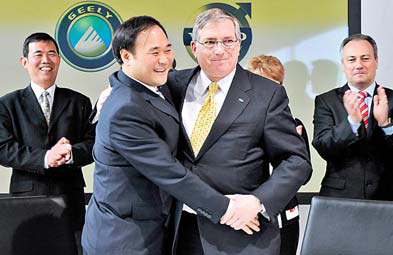
A Political Issue
As the Financial Times’ "Lex" column points out today, “(China’s) biggest auto deal to date is not a strictly private transaction”. Of the total purchase price of $1.8 billion, $1.6 billion is in cash. Of that amount, about half is coming from several local governments in China who will be “helping” Geely to build Volvo factories in their areas. In addition, about $900 million in working capital is coming from state-owned banks – the banks that are frequently criticized for lending only to state-owned companies.
Furthermore, now that a global luxury brand has Chinese ownership, we can be almost certain that the black sedan of choice for state officials will no longer be an Audi or a Mercedes. It will be a Volvo.
China’s government has made no secret of the fact that the state intends to remain the major player in the automobile industry, nor of their desire to build “national champions” able to compete on a global scale. Geely is ostensibly private, but it has needed government help to move into the big leagues, further blurring the line between public and private (an issue I highlighted in relation to Geely last June).
What will be the eventual cost of this help? Will Beijing now begin to have influence on Geely’s strategic direction?
As before, I think many Chinese may find this line of questioning a bit ridiculous: Well of course the government will expect something in return! This is how business works! The business brings in expertise, the government offers support. It is a symbiotic relationship.
I approached this question from a different direction just a few weeks ago in relation to the failed Hummer deal. Sichuan Tengzhong was unsuccessful in its bid for Hummer largely because the proposed deal was in violation of government policy. Geely has been successful in its bid for Volvo for the opposite reason: it is completely in keeping with government policy.
The lesson seems clear. The price of not following policy is likely to be failure. The reward for following policy is not only a greater chance of success, but also material support where needed – regardless of whether the business is private or state-owned. But what will be the price of following policy? For this we can only speculate at this point.
What is fascinating about this case, however, is that following government policy in China need not always be detrimental to business strategy. Perhaps the goals of both the government and Geely are met in this single transaction, and neither side loses.
To me, this is a mind-blowing revelation. Neo-liberal economic theory tells us that governments cannot run businesses because they are conflicted with political objectives (and perhaps the US government’s ownership of GM bears this out), but is China the exception that proves the rule, or has it found some way around the strictures of Western economic theory? Is China re-writing the rules of capitalism, or is it merely breaking them?
There is one other question this transaction raises, and it is more of a business issue than one of political economy.
A Business Issue
In discussing the Geely-Volvo deal with a (Chinese) executive at a Chinese automobile company about two months ago, I asked whether he thought Geely could manage Volvo if the deal were consummated. His response was that Geely would need a lot more money than it currently has.
As he explained it, an auto company not only needs to fund research and development for new models, but it also requires about $1 billion of R&D a year on each existing product line, just to keep the models fresh and to introduce incremental innovation. (The figure seemed high to me, so I asked again, and he repeated the number, $1 billion.)
“If Geely is relying on the government for at least half of a comparatively small purchase of Volvo, how can Geely possibly fund Volvo’s ongoing R&D pipeline? Add to this the likelihood that Ford has probably way underinvested in Volvo over the past few years. I’m not sure Li Shufu fully understands what he is getting into”.
Will Geely need to get further into bed with the state in order to feed the R&D pipeline? And if so, at what further cost, if any, will this help come?
Please note that this is the first in a series of several posts on this topic. Subsequent posts can be found here, here and here.
Follow-up Edit (August 2011): Please note that some of my initial speculation in this particular post about the meaning of certain Chinese terms proved to have been misguided. It is important to read the three posts that followed this one for a better understanding of these terms and the guo jin min tui phenomenon.
______________________
This is the first of at least a couple of posts on the topic of public vs private ownership of business in China. Chinese speakers may find the beginning of this post a bit tedious, but I want to lay out a few definitions for those who may be interested in the topic, but whose Chinese isn't quite up to speed.
Those who follow Chinese economic discourse may have noticed the terms 国退民进 and 国进民退 in the news recently. (I also wrote another post on this topic about a year ago.) If you speak Chinese, you already get the subtle -- yet profound -- difference between these two terms. For non-Chinese speakers, let me briefly explain these terms.
Each term contains two nouns and two verbs.
The nouns are:
国 meaning "state" (pronounced guo)
民 meaning "people" (pronounced min)
The verbs are:
进 meaning "to enter" (pronounced jin)
退 meaning "to withdraw" (pronounced tui)
So the first term "guo tui min jin" means "the state withdraws and the people enter". The second term "guo jin min tui" means the opposite: "the state enters and the people withdraw".
These two terms refer to processes. Guo tui min jin, at the risk of oversimplification, is basically the process of privatization. Guo jin min tui, again at the risk of oversimplification is the opposite: nationalization. From here forward, I will refer to these terms as "privatization" and "nationalization", respectively (quotation marks included). (Again, let me acknowledge that these are gross oversimplifications.)
One might think that these two terms emerged simultaneously in economic debate; however, those who have followed the Chinese economy for a decade or more know that this is not the case.
"Privatization" (国退民进) was first introduced over a decade ago to describe a deliberate continued policy of privatization that had begun under Prime Minister Zhu Rongji. The idea, at least on its surface, was that, as the state continued to withdraw from ownership of business, the people would gradually move in to take the state's place.
To determine to origin of "privatization" I consulted an official economic history of China which credits Professor Wang Jue (王珏) of the Central Party School for introducing the term in 2000.*
"Nationalization" (国进民退) did not really begin to emerge until very recently, but it did not emerge as a statement of policy. Rather it arose as a criticism of what appeared to be a reversal in economic reforms as the state's share of a number of important industries has begun to increase.
In order to determine whether my perception of the emergence of these terms matched reality, I consulted a couple of sources: a database of Chinese academic journals** and People's Daily, the main Communist Party daily newspaper.*** Below are two charts showing the trends in usage of these two terms.
This first chart shows that the number of academic articles using the term "privatization" (国退民进) became significant around 2000, and peaked around mid-decade before falling off significantly. The number of articles using the term "nationalization" (国进民退) did not become significant until around 2008, nearly surpassing usage of the other term, "privatization" in 2009.
The point here is that China's academic community appears to at least acknowledge a trend in behavior, if not in policy.

A search for these terms in the People's Daily archives yielded the following chart. Not quite as exciting (and with numbers so small as to be of questionable significance) the data seem to support the academic debate. "Privatization" clearly emerged as a policy around 2000, got a few mentions around mid-decade, then barely got a mention in 2009 -- except possibly in contrast to mentions of "nationalization" which began to show up for the first time last year.

So clearly, there is some sort of a debate going on in China. But this is China, so the debate cannot be very vigorous, nor can it be held in the open, right? While the average Chinese may not be surprised to learn this, the richness of debate taking place in China, particularly in the economic arena, may surprise some outside observers.
A fascinating article about this debate was published this week in China Economic Weekly, a news weekly published by People's Daily. (Thanks to Paul Denlinger for bringing this article to my attention.) The article, entitled “国进民退” 真伪 is the cover story of this week’s issue, and, roughly translated, it means, “'Nationalization' True or False?”
Over several pages, the article presents a fascinating debate that has been taking place in China over the past year, and that managed to generate some attention during the recent annual meeting of the National Peoples Congress. Is the Hu-Wen government really in the process of re-nationalizing a lot of the enterprises that were privatized under Zhu Rongji and Jiang Zemin?
In a later post, I will summarize the debate and identify some of the players. I will also take a look at the origin of the term "privatization" (国退民进) to determine whether the original meaning was everything we thought it was (or is).
The next post in this series can be found here.
________________________
* 章迪诚,著,中国国有企业改革编年史,(北京:中国工人出版社,2006) pp.556-7.
** CNKI.com database of full-text Chinese academic journals, through UCLA East Asian Library.
*** http://search.peopledaily.com.cn.
Follow-up Edit (August 2011): Please note that some of my initial speculation in this particular post about the meaning of certain Chinese terms proved to have been misguided. It is important to read the three posts that followed this one for a better understanding of these terms and the guo jin min tui phenomenon.
______________________
This is the first of at least a couple of posts on the topic of public vs private ownership of business in China. Chinese speakers may find the beginning of this post a bit tedious, but I want to lay out a few definitions for those who may be interested in the topic, but whose Chinese isn't quite up to speed.
Those who follow Chinese economic discourse may have noticed the terms 国退民进 and 国进民退 in the news recently. (I also wrote another post on this topic about a year ago.) If you speak Chinese, you already get the subtle -- yet profound -- difference between these two terms. For non-Chinese speakers, let me briefly explain these terms.
Each term contains two nouns and two verbs.
The nouns are:
国 meaning "state" (pronounced guo)
民 meaning "people" (pronounced min)
The verbs are:
进 meaning "to enter" (pronounced jin)
退 meaning "to withdraw" (pronounced tui)
So the first term "guo tui min jin" means "the state withdraws and the people enter". The second term "guo jin min tui" means the opposite: "the state enters and the people withdraw".
These two terms refer to processes. Guo tui min jin, at the risk of oversimplification, is basically the process of privatization. Guo jin min tui, again at the risk of oversimplification is the opposite: nationalization. From here forward, I will refer to these terms as "privatization" and "nationalization", respectively (quotation marks included). (Again, let me acknowledge that these are gross oversimplifications.)
One might think that these two terms emerged simultaneously in economic debate; however, those who have followed the Chinese economy for a decade or more know that this is not the case.
"Privatization" (国退民进) was first introduced over a decade ago to describe a deliberate continued policy of privatization that had begun under Prime Minister Zhu Rongji. The idea, at least on its surface, was that, as the state continued to withdraw from ownership of business, the people would gradually move in to take the state's place.
To determine to origin of "privatization" I consulted an official economic history of China which credits Professor Wang Jue (王珏) of the Central Party School for introducing the term in 2000.*
"Nationalization" (国进民退) did not really begin to emerge until very recently, but it did not emerge as a statement of policy. Rather it arose as a criticism of what appeared to be a reversal in economic reforms as the state's share of a number of important industries has begun to increase.
In order to determine whether my perception of the emergence of these terms matched reality, I consulted a couple of sources: a database of Chinese academic journals** and People's Daily, the main Communist Party daily newspaper.*** Below are two charts showing the trends in usage of these two terms.
This first chart shows that the number of academic articles using the term "privatization" (国退民进) became significant around 2000, and peaked around mid-decade before falling off significantly. The number of articles using the term "nationalization" (国进民退) did not become significant until around 2008, nearly surpassing usage of the other term, "privatization" in 2009.
The point here is that China's academic community appears to at least acknowledge a trend in behavior, if not in policy.
A search for these terms in the People's Daily archives yielded the following chart. Not quite as exciting (and with numbers so small as to be of questionable significance) the data seem to support the academic debate. "Privatization" clearly emerged as a policy around 2000, got a few mentions around mid-decade, then barely got a mention in 2009 -- except possibly in contrast to mentions of "nationalization" which began to show up for the first time last year.
So clearly, there is some sort of a debate going on in China. But this is China, so the debate cannot be very vigorous, nor can it be held in the open, right? While the average Chinese may not be surprised to learn this, the richness of debate taking place in China, particularly in the economic arena, may surprise some outside observers.
A fascinating article about this debate was published this week in China Economic Weekly, a news weekly published by People's Daily. (Thanks to Paul Denlinger for bringing this article to my attention.) The article, entitled “国进民退” 真伪 is the cover story of this week’s issue, and, roughly translated, it means, “'Nationalization' True or False?”
Over several pages, the article presents a fascinating debate that has been taking place in China over the past year, and that managed to generate some attention during the recent annual meeting of the National Peoples Congress. Is the Hu-Wen government really in the process of re-nationalizing a lot of the enterprises that were privatized under Zhu Rongji and Jiang Zemin?
In a later post, I will summarize the debate and identify some of the players. I will also take a look at the origin of the term "privatization" (国退民进) to determine whether the original meaning was everything we thought it was (or is).
The next post in this series can be found here.
________________________
* 章迪诚,著,中国国有企业改革编年史,(北京:中国工人出版社,2006) pp.556-7.
** CNKI.com database of full-text Chinese academic journals, through UCLA East Asian Library.
*** http://search.peopledaily.com.cn.
Last June, news first surfaced that General Motors (GM) had found a buyer to take its much loved and hated Hummer brand off its hands. The prospective buyer, Sichuan Tengzhong, a maker of heavy equipment came from out of nowhere to make a bid for the Hummer brand. (Please see previous posts on Tengzhong here and here.)

Auto industry related people I spoke with in China at the time told me that the CEO of Tengzhong was friends with the heads of a lot of mining companies who are also customers of Tengzhong's heavy equipment. Most of the miners favored Hummers as their personal vehicles, so Tengzhong's CEO jumped at the opportunity to grab the American icon. Of course, this was only hearsay.
As of today, the Hummer deal still has yet to be approved by China's Ministry of Commerce which has the authority to approve outbound investment by Chinese companies. Why is it taking so long?
This article by Patti Waldmeir of the Financial Times contains a few quotes that very nicely sum up the reason:
Beijing's problem with the Hummer purchase is very simple: it violates policy. Support, or lack thereof, doesn't appear to stem from whether an auto company is state-owned or private (BAIC and Geely, are, respectively, an SOE and a private company), but from whether a potential deal conforms to central government policy. The current policy in force calls for both improvements in the environmental impact of automobiles and consolidation of China's many automakers into fewer, larger companies that will be more competitive on a global scale.
So that's the end of it, right?
Not quite. Apparently Tengzhong remains so keen to get its hands on Hummer that it will try an end-around. This article from Reuters reports:
Furthermore, the offshore route will probably require the use of foreign exchange (which, again, is controlled by the Central Government) to complete the deal -- that is, unless GM could be persuaded to sell Hummer for non-convertible Chinese Renminbi.
If I had to bet, I'd say this deal isn't going to happen.
___________________
UPDATE: About 24 hours after I posted the above, official word has come from GM. The Tengzhong deal is off, and Hummer will be wound down.
While this may sound like the end for Hummer, there may still be a faint glimmer of hope. GM has previously said the same of both Saturn and Saab after their respective deals fell through. Though Saturn is indeed being wound down, Saab was rescued at the 11th hour by Dutch investor group Spyker Cars.
And now Sichuan Tengzhong can return to the obscurity from whence it came.

Auto industry related people I spoke with in China at the time told me that the CEO of Tengzhong was friends with the heads of a lot of mining companies who are also customers of Tengzhong's heavy equipment. Most of the miners favored Hummers as their personal vehicles, so Tengzhong's CEO jumped at the opportunity to grab the American icon. Of course, this was only hearsay.
As of today, the Hummer deal still has yet to be approved by China's Ministry of Commerce which has the authority to approve outbound investment by Chinese companies. Why is it taking so long?
This article by Patti Waldmeir of the Financial Times contains a few quotes that very nicely sum up the reason:
Producing the hulking Hummer, with its image of wasteful excess, could hardly be less consistent with Beijing’s pro-green automotive policies, said Mike Dunne of Dunne & Co, an Asia-based automotive consultancy: “For them to approve the Hummer deal would be a big contradiction”.Beijing isn't against purchase of foreign auto companies and assets, as can be seen by its support for Shanghai/Nanjing Auto's purchase of MG-Rover in 2007, and more recently, BAIC's purchase of Saab technology and Geely's (ongoing) attempt to buy Volvo from Ford.
The deal would violate not just Beijing’s environmental goals but also the government’s insistence on consolidation in the Chinese car industry, which has up to 100 carmakers, according to Yale Zhang of CSM Automotive in Shanghai.
Beijing's problem with the Hummer purchase is very simple: it violates policy. Support, or lack thereof, doesn't appear to stem from whether an auto company is state-owned or private (BAIC and Geely, are, respectively, an SOE and a private company), but from whether a potential deal conforms to central government policy. The current policy in force calls for both improvements in the environmental impact of automobiles and consolidation of China's many automakers into fewer, larger companies that will be more competitive on a global scale.
So that's the end of it, right?
Not quite. Apparently Tengzhong remains so keen to get its hands on Hummer that it will try an end-around. This article from Reuters reports:
"Tengzhong has not given up hope yet to win government approval, but buying Hummer through an offshore investment vehicle could be an option if it can't get the green light," said a source close to the deal, who asked for anonymity due to the sensitivity of the issue.So Tengzhong could, theoretically, establish an offshore entity to purchase Hummer. And as long as Hummer production isn't brought onshore, there wouldn't be a problem. But then Tengzhong would lose the ability to take advantage of China's lower cost labor force. Tengzhong could also run into issues with a sorely disappointed Central Government when trying to import Hummers manufactured abroad.
Furthermore, the offshore route will probably require the use of foreign exchange (which, again, is controlled by the Central Government) to complete the deal -- that is, unless GM could be persuaded to sell Hummer for non-convertible Chinese Renminbi.
If I had to bet, I'd say this deal isn't going to happen.
___________________
UPDATE: About 24 hours after I posted the above, official word has come from GM. The Tengzhong deal is off, and Hummer will be wound down.
While this may sound like the end for Hummer, there may still be a faint glimmer of hope. GM has previously said the same of both Saturn and Saab after their respective deals fell through. Though Saturn is indeed being wound down, Saab was rescued at the 11th hour by Dutch investor group Spyker Cars.
And now Sichuan Tengzhong can return to the obscurity from whence it came.
As I near the end of my current data-gathering trip in China (which has lasted longer than I expected), I anticipate another year or so of analysis and writing. Needless to say, I have neglected my blog in recent months, but I hope to remedy that after my return to the States. My last couple of months have been a mad dash to complete as many interviews as possible, and get out of China before Spring Festival.
In the meantime, here's a link to a short interview I did with Michael McCune of the China Business Network. The content of the intro paragraph doesn't entirely reflect my views (I wouldn't say that BYD, Geely and SAIC-GM are all "full steam ahead" in development of low emission vehicles -- really, only BYD is), and the text says that BYD is in "Tianjin" (it's in Shenzhen). But aside from that, the interview does accurately reflect some of what I have learned over the past year.
China Business Network: "China's Auto Makers Shift into High Gear"

Subscribe to:
Posts (Atom)


